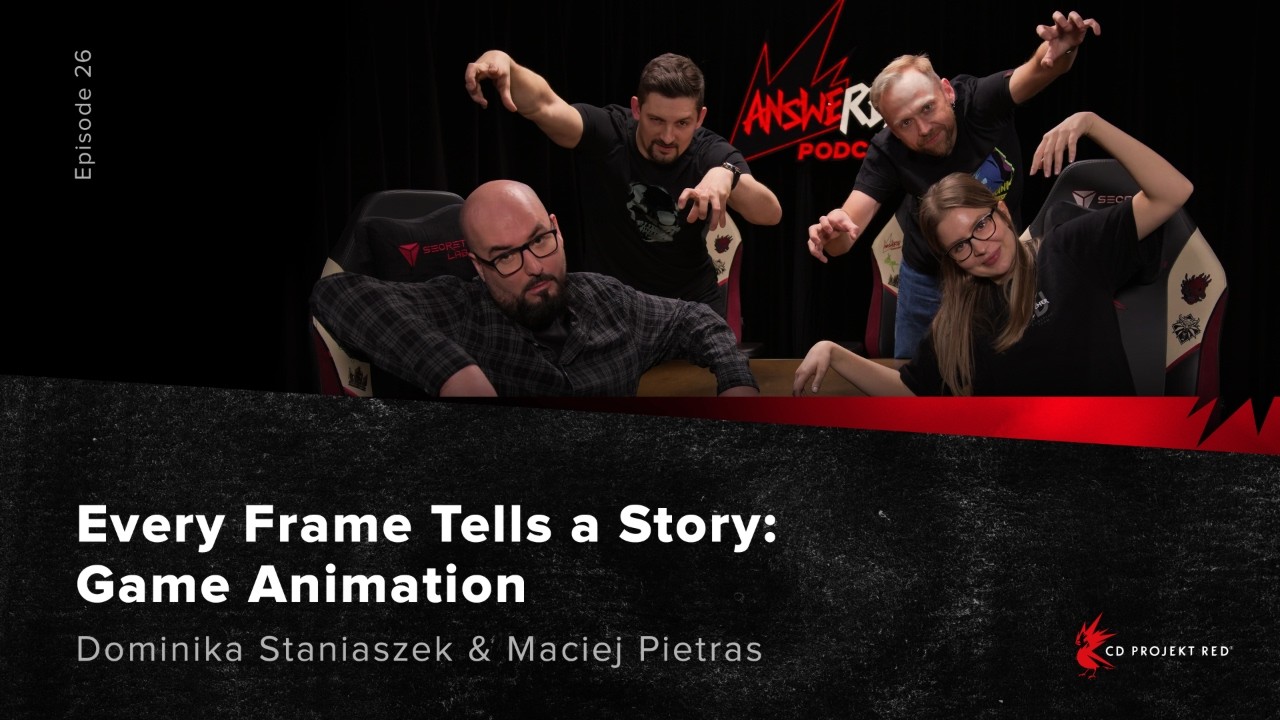
Every Frame Tells a Story: Game Animation [transcript included]
![Every Frame Tells a Story: Game Animation [transcript included]](https://common.cdn.cdpr.app/cdpr/news/main/2fdbd8266a6a573ac40f0c58e71682b5_q90_1280x720.png)
Sometimes, realism in animation means speeding up an action by 20% or changing a character’s proportions — all in the name of making games feel responsive and immersive! This creative sleight-of-hand is an important tool in an animator’s arsenal, and knowing how to properly achieve it is part of how we’re raising the bar between The Witcher 3 and The Witcher 4.
For Episode 26 of AnsweRED Podcast, Senior Gameplay Animator - Coordinator Dominika Staniaszek and Animation Director Maciej Pietras joined hosts Paweł Burza and Paweł Mielniczuk to swap anecdotes and share insights from over 6 and 12 years of work at CD PROJEKT RED respectively.
Tune in to learn about:
- How Animation Directors guarantee quality and team cohesion
- The difference between cinematic and combat animation
- How to prepare an animation portfolio when applying for roles
- What’s changing between The Witcher 3 and The Witcher 4
This episode also contains plenty of insights into the feedback process, including the importance of noises, hand gestures, and recordings! Tune in to learn more about how our teams are structured and how they’re approaching the important work ahead of them.
Click here to reveal the full transcript
This transcript has been lightly edited for clarity.
Paweł B: Hello and welcome to the AnsweRED Podcast. My name is Paweł Burza and as always, I am joined by another Paweł, Paweł Mielniczuk the Art Director for Project Hadar.
Paweł M: Hey, Paweł. Today we'll talk about the complex world of animation and discuss how to change from The Witcher 3 to The Witcher 4. And our guests will be Dominika Staniaszek, Senior Gameplay Animation Coordinator and Maciej Pietras, Animation Director.
Paweł B: As you probably know, animation is pretty cool. You can move someone the way you want them to move. As a puppet master, I would say. But I will not be trying my hand in animation. Let's hear from our guests who are specialists on the topic, so let's meet them.
Paweł B: Maciek, Dominika, welcome to the podcast officially. Topic for today is animation. But before we start, could you both introduce yourselves?
Dominika: Yeah? Hello. Nice to see you. I'm Dominika, I'm a Senior Gameplay Animator here in CDPR. It's my sixth year in the company, and I'm also a coordinator of player combat and human enemies combat.
Paweł B: On The Witcher 4.
Dominika: Yes, Witcher.
Paweł B: Nice.
Maciej: And I'm Maciej Pietras. I'm Animation Director on Witcher 4, and I'm responsible for making sure that animations in Witcher 4 are as good as possible, while also helping everyone inside animation team, including Dominika, to make sure that the way she can work is the best way to achieve the best quality of animations.
Paweł B: Awesome.
Paweł M: All right, so let's start super general. So tell me if that statement is true, that animation is like bass in a rock song: until it's missing you don't notice it. [laughs]
Maciej: That's good.
Paweł B: But if it sucks, well, you know it sucks.
Maciej: Yes and no, I guess. Like, I think it's partially true. I don't know if you would agree with this, but—
Dominika: I would say it is a bit true, because one thing that I can say, it's like when you have a bug in game and something is not working, the first thing people assume it's animation's fault, and then we have to prove it's not our fault, not the other way around. So even if it's called design implementation, we have to prove it's not us, not the other way around.
Maciej: Yeah, not to get too technical, but like any time someone is like, oh, the animation is T-posing, you know, doing the pose thing, oh, it's animation’s fault. I'm like... 90% of cases, not. But going back to the bass thing, I think from my perspective, it's kind of true when it comes especially to how animation is placed within the entire aesthetic. Like to use the music example inside a song, you know, it's part of it. So you cannot just artificially remove it or not make it sound bad, but so of course it's a very integral part of the entire visual side of the game or of whatever media it is.
Paweł M: I have a feeling that, um, to make something super realistic, like CGI, movies or games, it feels really realistic, you first of all need to have perfect animation. So there's some examples like Unrecord demo, some kind of FPS game that was released some time ago, or like Alberto Mielgo animations of those robots, they're stylized characters. You know, there's no realism in how the world is presented, but the animation is so realistic that you instantly feel it.
Maciej: Yeah, yeah, I agree. Actually, like even looking at The Witcher 4 tech demo we did, right? This was the very first time we ever did performance capture. So the moment when you actually record face, voice and body at the same time and, you know, for us it was a big challenge because actually inside the company, inside the animation team — we didn't have much experience with it. You know, obviously we had a lot of help from Epic, but what we came to realize is that the way performance capture works in video games, especially since it's, you know, everything is real time. It works only, again with the music example, it got stuck in my head now, it only works when everything else is working together. For instance, if the lightning is not super correct in a way that is fitting the realism of how detailed the characters are. If the shader of the skin is not, I don't know, translucent enough, or there's something weird with the shading. Suddenly the picture looks just off, and I think it's really very much connected to the way we are going towards, you know, a little bit more realistic visuals, you know, with each year, with each generation of technical upgrades that we see inside the industry. I think it's one of those things that really do stand out is that if you are aiming for realism, there is a point where everything needs to work really well together because it actually can work not in your favor if one of the aspects is done too good, right? So let's say the characters are so realistic and the animation is not really there.
Paweł M: Uncanny valley?
Maciej: You got the uncanny valley. And that's the most difficult place to be in because, you know, in order to jump over the uncanny valley or at least try to climb uphill of that thing, I think it's the only way is just working together very, very well and constantly iterating with the team. Because for me, when it comes to performance and scenes, the way characters act, how they behave, it all starts with the actor, with the script, right when you're on the set and you're trying to find that thing and be like, yes, that's good. Now we'll see it in six months, right? Because let's say that's how long it takes to make a scene from the mocap suit to the actual, how it looks in the game. So I think it's very much connected with how everything works together. And I don't think there's a, there's an easy — again, animation is visual. So it's very easy to point this out. Oh, he blinks weird, right? But you know it might not be the blink. It might be the eyelids. It might be the actual lashes of the eyes that are obscuring the iris of the eye. And suddenly, you know, you're having a discussion with six different departments basically on, hey, how can we fix that? And then you try and then you change it. And I think that's one of the biggest, you know, for me.
Paweł B: I think we also see it very quickly because it's things that are connected to how the human appearance is and what we do. And we see this doesn't look like a human. This is like, you know, totally different. Now that you mentioned the tech demo that we did for The Witcher 4, uh, during Unreal Fest because there at the end, we have Ciri talking with the merchant and her facial expression is very animated, which also a lot of players saw, and they're like, I really like the character that she's kind of like having because Geralt, I mean, he's very toned down. He's very like, doesn't show a lot of emotions. Well, she's very playful when she's talking with him, which is like super cool because it showcases her personality. But also it just feels like it's a step above what is happening in the industry. So right now we're moving towards things looking so realistic that soon it's just, you know, like there's going to be no gap between — because always games you look at characters, they're like, yeah, he's kind of like his lips are moving kind of okayish. But I can see it's not very human-like. And sometimes some of the things that they do with their, you know, hands or eyes are very robotic. And now we're kind of moving into a direction where everything is very super-fluid and human-like almost.
Maciej: Yeah. For sure. I think a big part of it is exactly that pursuit of realism. But at the same time, you know, our games are kind of famous for being kind of stylized. So for me, it kind of feels like there's a double challenge there, because at the same time, we're pushing the realism of the graphics, and then at the same time, we do have a little bit stylized characters. So obviously we are trying to merge the two paths at the same time, which is not an easy task, of course. And that shot in the tech demo, I think it was one of our true breaking ground of like, okay, how does it work? We learned tons. We're still learning, you know, and it's extremely exciting. But at the same time, it does require from us to actually look at a lot of the things from a completely different perspective. Some stuff that we assumed would be simple turns out to be extremely complex. And because of that, we need to be very, very, very agile here and really think about all the stages of animation, how we produce it.
Paweł B: For both of you a question: how would you define a great animator? Because I feel like with kind of all the technology that is around us and also with the amount of complexity, how games are growing, they're almost becoming — some cutscenes in games look like, you know, short feature films or CGI and stuff like that. It's like, what type of skill set do you need to have? And what makes a great animator stand out from, let's say, an animator that is okayish?
Dominika: So I can say about gameplay, okay, because I'm working in gameplay, but I would say that the thing that is the most important for us is that we need people who understand that they are not just animators, they are game developers. So it's not only about animation and doing great short, it has to work in-game. So it's about this understanding that it's not animation that is your art. The game is your art kind of, right? So this is the final product and this is what you should have in mind. So I think actually this is the mindset of a great animator, gameplay animator, versus just an animator who focuses on animation itself and that's it.
Maciej: Mhm.
Paweł M: And so you're gameplay animator and Maciej I know your background is in animation. So we have those two areas. Are there more areas where animation plays a role in game development?
Maciej: Yeah, of course. Like we have the — inside of the like, because I cover entire animation on the project. So obviously we have cinematic animation, which, you know, I did start in 12 years ago at CD PROJEKT, right. Um, and then we have, uh, gameplay animation where Dominika is working. But of course we have a lot more teams, to be honest, if I can list them, it's we also have the monsters team where, you know, animators are so focused on just creating the best possible, scariest and creepy but kind of fun monsters that we kill in multiple ways because that's also exciting.
Paweł B: Yeah.
Maciej: Yeah, it's all about, you know, obviously there was a manticore in the tech demo, but I think, you know, then you have, that's monsters. And then you have the tech animation, which is a discipline of its own. But we try here, we try to keep that theme as ingrained within the entire animation team as possible. And because of the challenges of the project that we want to pose for ourselves. Of course our tech animation is working on so many things connected together with gameplay, connected with cinematics. And that division makes those people who are, you know, they're technical first, but also have great sense for animation, which is like best of both worlds, to be honest. And it's a very difficult role. But they are helping basically establish everything that is connected with the animation. They're like a bridge between programmers and animators, and they focus mostly on in our company, working inside the engine to make sure that the way we create animations, the way the animations are being used within the company, within Unreal, is able to create something that animators alone don't often have the possibility to create themselves. Because, you know, comparing like pure CGI scenes, for instance. The animation is done and it's not touched in any way. But in games when you work with real time, let's say Ciri. Ciri is casting a spell. The monster is moving where Ciri is casting a spell so her hand needs to move across the screen. Oh, but she's also, player's also moving Ciri at the same time. So she needs to start walking, but she's there in this casting spell animation, so suddenly her feet are walking, her foot is moving, she's moving, the hand is moving, and suddenly—
Paweł M: She's blinking.
Maciej: And she's blinking and she's looking. So you got—
Paweł M: Secondary motion—
Maciej: You got like.
Paweł M: She has all this cloth, for example — elements, which are moving.
Maciej: Exactly. So it's a layer on layer. It's like a multiple layered cake where everything needs to work together. So in this example with the cake, the tech animators are those people who are responsible to make sure that the layers are correctly set up, to make sure the coding, the final layer, everything just works together and it's one.
Paweł B: Needs to be like a cake. All the layers need to be even, proportionate.
Maciej: Or like an onion.
Paweł B: Or like an onion, yeah.
Maciej: Yeah, you know. Both have layers.
Paweł M: So many layers to break that the funniest bloopers in the game are from animation.
Maciej: Of course, of course.
Paweł B: Limbs flying in different directions. T-posing, all that jazz. Yeah.
Paweł M: How to foresee that? How much technology is involved in, for example, animating how Ciri moves?
Dominika: I would say a lot. So as Maciek said the technical animator, they are essential I would say. Like, we wouldn't be able to do anything without them and a majority of issues that we have, for example, if we want to cut scope, right? We go to them and we ask what they can help us with, what they can do that will allow us to cut the scope or have some idea to to resolve some issue in a different way. But it's really, really important. I would say they are essential to our team.
Paweł M: Okay.
Paweł B: In the game design pipeline, or the life cycle of a game, how early in a project does animation jump in to start working on things? Because sometimes we know early concepts of a game can be rough around the edges. Some of the animations might not be final. They might be just, you know, placeholders there. So when do you start already working on all these things?
Maciej: That's cool because I think it's a throwback to what Dominika said. Like game animators in general. The way we do this, so part of what I pitch whenever we hire anyone in the company is that you need to be a game developer first. An animator second as a discipline, right? It's a model we have had in animation for years. And because of that, we kind of require animators when they start on a project to be actually involved from the get go. Because think about it like when I started working on Polaris, I was one of the first people inside the team. And when I think about it, I didn't animate for a year because I was just talking with writers, with quest designers, with gameplay designers, to understand what are they even thinking about? To have this moment of — which actually, you know, it happened for me, it happened with the performance capture, with capturing the face and the voice at the same time. We had this moment when everything kind of fell into place very early on, on the project when it was like, oh my God, we have to change the way we make scenes in the entire company, like from this moment on. This technology allows us to do stuff at the level that we could never do before because you know, on Witcher 3, facial animation was all done manually. It was all keyframe. In the dialog scenes, obviously the mouth, the lip sync was generated based on the voice over. Um.
Paweł M: Because we have so many languages.
Maciej: So many languages. The game has 38 hours of scenes, only three hours of dedicated cinematics. And we did the game in 11 languages, right? So it's physically impossible to do all that. So we have to rely on certain technologies that just help us speed things up. But I had, going back to my initial thought about this moment of reflection of the reason why I came to this conclusion that performance capture is absolutely a must-have for the project. It was because I did spend 12 months, I guess just talking with everyone and how realistic we want to portray Ciri. Like we want the player to not only read or hear the emotions that are going through her when she's on her journey, but actually to also see it. So we want to really show that in this case on her face. And then of course, you know, as things do happen, we realize like, oh, there's the whole thing within moving to Unreal, to the new engine. And we might do this tech demo in the future. So what technologies we could use there? And we're like, oh, how about we do everything we ever thought about that is just cutting edge of the technology? Even at this point, with so many technologies that we did showcase on Unreal Fest. I think this year and I think last year, and this allows us to actually, uh, you know, push the boundaries. But the reason why we are able to do that during creation of a project is because we were engaged from the start. And I, you know, whatever animator starts at the company, I think during our onboarding, we have this thing when we want them to read the story. Like, you know, you need to know what the game is about, right? Then you go through the entire documentation of how we make games. And then you start thinking and reading and learning from your peers about how we actually make animations, right? And I think this layered approach also comes down to every single thing we do.
Paweł B: Yeah, I think calibrating is always important at the start of any project. Like anyone, everybody needs to be on the same page in terms of like what the game is and what kind of the idea for it is. Because sometimes we might have ideas that are kind of like, you know, we want it to be this. And then we also need to discuss, okay, how do you envision this? For example. Yeah. So if you had to draw a line between gameplay animation and cinematic animation, if you could, like, pinpoint things that kind of go into both buckets, what would you say are the things for someone that's trying to, like, understand the biggest differences here?
Paweł M: Hm.
Dominika: Well, I can say what I think.
Paweł B: Yeah.
Dominika: Because I never worked in cinematics. So I don't have a comparison. But in gameplay, what counts the most is player experience at the end. Right? So everything we do, we do with this in mind. So we are not focusing — of course we want our animation to look great, right? But our main focus is to create the best experience for player. And we work on a bit different assets. Our assets are short, there are a lot of connections that need to happen because you know you have systems. Player can do whatever. He can go from one animation to ten others, right. And they all have to work between themselves, which I don't know if it's the case in cinematics because usually probably they just get the scene, although they have also open world assets, right? And yes.
Maciej: It's much more complicated.
Dominika: Yes, yes. So that's the thing.
Paweł M: I guess in gameplay, timing is very—
Dominika: Yes. And it's different.
Paweł M: Not always realistic with the timing.
Dominika: This is another thing that I wanted to say, that gameplay animators have to be aware of a different timing. Like for the gameplay. And also it's really important that we have really readable poses because player needs to know when to hit or when the input should happen. So there are those differences, different anticipations. So there are differences between us. But there are also similarities.
Paweł M: So what you're saying is a lot more more probably stylization in gameplay animation because of those poses of communicating those actions like timings that are snappy, not always realistic.
Dominika: Yes, exactly.
Paweł M: In cinematics, we make a movie, right?
Maciej: Yeah, yeah.
Paweł B: I think that's also cool because in some games you specifically look for specific animations that your opponent is doing because you know that, okay. If it's like a big guy that has like brute force and he's gonna be a little bit slower, if it's someone that is quick on his feet and you know when you should attack, react or where is kind of the opening that you can utilize to your advantage? Yeah.
Dominika: Another thing is camera, right. You know, in majority of game cinematics they have static camera. So you animate for the camera and in gameplay the camera can be... Anywhere.
Maciej: I think it's, from my perspective I absolutely agree with everything what you said because like, yes, this is exactly how it feels to work on gameplay animations. Like the timing that you mentioned, both mentioned. I think that's one of the things that stands out the most as a difference, just from a pure visual perspective. When you look at the animation that has been done, for instance, for player, right? The jump animations. Oh, my favorite are jump animations. If you try to jump as a human being, even if you're extremely athletic, you gotta take some time to wind up, crunch down, and then lift off, right? It takes time. It's not going to take, what, zero seven second, as we have in the game. Right? When you press that button and that button needs to respond to an action in in such a short time that it is the biggest, I think from the perspective of creating animations for the player. I think this is the biggest difference, because it really is so impactful on everything that we do in the gameplay animation.
Paweł M: It doesn't have to, but then it just feels slow.
Dominika: Yeah.
Paweł M: You don't have control.
Maciej: Unresponsive. Right? That's the term we use, like, oh that's unresponsive. Right. It just doesn't move. It doesn't make sense. So that's you know, one of the biggest challenges also creating games is that you work in real time. That stuff needs to be, I press a button and I see something and like, oh, nothing happens. Oh now it happens. So like, oh, no. So there's a lot more reworking, right? From my perspective, the difference is also that the way we are divided within the company between gameplay and narrative animation as a whole, who people have worked on scenes and cutscenes and open world animations, that division kind of also makes, uh, additional layer of the cake of complication is because, you know, in gameplay, very often you are working on one character or one set of animations for a little extended period of time, let's say, let's say six weeks, right? In cinematics you are working on 600 things during those six weeks. They can be connected. They can be belonging to a certain scene. But that's not how we work. The way we work in cinematics is that they work within a content team, and that content team is working on multiple quests with multiple characters, and they are working together with narrative designers and story writers and other people who are working within that content team to create the experience that is extremely coherent, but not looking at a singular feature or an animation even. So that is another difference. And the other one is, is the amount of technical aspects. I think that's kind of similar is that both team—
Dominika: I think cinematics, they also have difficulties with that. It's really complicated.
Maciej: Yeah it is, it is especially with our games, you know, like action, RPG, narrative, open world. Those kinds of games are from my perspective, are kind of the most complicated types of games you want to do because you're not only worried about what player sees in that particular moment, but let's say they see a, you know, a guy fishing. So he sits by the pond and fishes during the day, and then he goes to eat something. Then he goes to sleep. Then, I don't know, maybe he's bored and he walks around the forest picking berries. Um, and that kind of ecosystem approach to creating animation is something that, you know, it's also a different mindset for those animators. So while, you know, it feels like we call them cinematics, for us, it's kind of like narrative, like you're creating an experience that they will experience from completely unknown angles, a different time, and you have to take it into account. So many multiple possibilities of what can happen. And I think it's very important that, um, that division, at the same time there are different, but at the same time they are kind of the same. It's a very difficult thing to actually, you know, to describe when it comes to literally like, are they different or how much they are different. Like I wouldn't be able to put a percentage difference on this.
Paweł M: And, uh, you mentioned the animations in gameplay are very short. So let's say a character walking forward doing this, all this stuff that you said about Ciri. So it's not one animation?
Dominika: No, no. Like a locomotion set, for example, in Cyberpunk I think one set. So for example, combat locomotion was like 80 animations or something like that. And I think now it will be even more. Uh, so no, it's not just walking forward. You have a loop, but then you have 50 transitions, right. Like turning left, turning right from idle to left, from idle to right, from walking to running, running to walking all the possibilities you have to cover. So, you know, there are animations that are longer, of course, but then you have all those types of short transitions or things like that that you have to also cover. So the sets are big. The sets are big. Yeah.
Paweł B: For both of your fields what's most important? Because I feel like for the cinematic part, realism is super important. So everything feels as real as possible for gameplay. You mentioned fun. And what's cool for gamers sometimes. So sometimes you would say that maybe let's make it less realistic, but let's make it freaking cool, right?
Dominika: Of course, like I can tell you, the first thing that we do after we get mocap, we speed it up by 20% or 30%. Because you know, even if on stage you see the actor and it seems so fast and agile, right? You would see it in the game and you would feel like it's so slow, like, it's unrealistic almost. Right. And then you want to have responsiveness in the game. So it needs to be really fast, responsive. So you change the timing a lot. You edit this mocap a lot. So even if we use a lot of mocap, those assets are edited to a point. You barely can see this mocap anymore. Right? Because it has to work in a game.
Paweł B: And cinematics, I assume realism.
Maciej: Yeah, yeah. We always strive for a certain amount of realism. Even within gameplay animation. It has to work within the context of the world of the entire game. Right? Because you have gameplay, then you have some scenes, then you just walk around the world, right? So you have to have this realism also in gameplay, like it's not let's say to the point where it's cartoony. Yeah, of course. No, it's still realistic. So it makes sense. It's just it's a very weird and specific thing. For instance, the sword swinging right whenever Ciri's swinging her sword. Those animations like 20, 30% sped up because otherwise it feels light or just wrong.
Dominika: Yes. To be realistic, you have to edit reality. Basically. Yeah.
Paweł M: Counterintuitive.
Maciej: It's counterintuitive. Absolutely. And I think it's also very much connected with the way we, you know, we do whatever in animation. You know, when you start learning animation, you know, you shoot a video, a video reference, and then you try to just frame by frame, understand the mechanics behind that motion, assuming the model you're working with is also realistic. As soon as you put any creature or any kind of like a character, which is like from a cartoon and use the same reference, it will look super weird. It's kind of connected with uncanny valley, but it's also connected with the fact that, let's say the character has, you know, super, super skinny, thin legs. Right? And a huge, bulky and small head. Right. Like it won't translate 1 to 1.
Paweł B: Yeah.
Maciej: So we have to always take that into consideration that everything needs to fit the bigger picture. But at the same time, a lot of the animation work that we're doing is adjusting everything to the same realism of the game. Right? Um, so we sometimes use the term stylized realism, which kind of is the best description of what we do. Some things are going to be more stylized because they do require player input, instant responsiveness, and some things we just let play. So in cinematics in the open world, yes, we can strive for full realism as much as possible. Um, because they are not player controlled like we are showing things to the player from the perspective of the game. So always in both departments we have to think about the player first. Um, but it's a little bit different because of this more focus on the realism. Right. But then the question that automatically we start posing on each other, on us is like, how far are we going?
Dominika: Yeah.
Maciej: Because like, can we do that everywhere? Like can we maintain this quality? And you know, how difficult it's gonna be, right? Maybe we can. So we set up certain, um, descriptions for each kind of level where everything is okay, where everything is okay, that's good, that's good enough. Um, and we try to, you know, just stop working. The problem with animators is they never know when to stop working. They never do. They never do.
Paweł B: That's an overall problem, I think, in this company, also applies to artists, I want to say, but I don't know.
Paweł M: But I'm sure there are some obvious limits. Like for example, with open world animations you mentioned, like there's probably they're not the highest top priority, right? Cinematics are more important. There's a limit of them we can do, but it can't be small so the world doesn't look believable or looks fake because you keep seeing the same thing happening.
Maciej: Yeah, I think that's for me. You know, having worked on Witcher 3 and now on Witcher 4, for me this is the biggest change we're trying to make. We're really trying to focus on the open world. And the stuff that we showcased in the tech demo was the apples, the going through the crowd, you know,
Paweł B: The bear.
Maciej: The bear, right. All the stuff connected with this new technology, with the synchronized motion matching, all this stuff, like those things are at the backbone of how we wanted to change the way we create open world to not make it only like, you know, just sometimes you're gonna see, of course, you're gonna see some animations that happen before if you play the game for, let's say, you know, 50, 60, 100 hours. But then, you know, we are trying to do something we never did before, not in Cyberpunk, not in The Witcher 3, where we are really trying to put as much work into the world as possible to have those, you know, sometimes one off moments, you know, when when you see something that might be kind of unique, and then it happens and you can remember relate to that, even though it's not directly connected with the story or character, it's just the lore. It's the world that we're building. And the way we started to approach those things in this project is that, okay let's start with the village. Let's start with something that surrounds the— what kind of village is this? Right? What kind of people live there? Is there a main profession in this village? Like, let's say there's a big blacksmith. Okay, so, where does he get the iron from? Or maybe there's a mine, or maybe there's a bog. And inside that bog, there's I think it's called bog iron. And people are like those, clumps of dirty metal. They put them in a bag and they go to the village and they need to melt it. Okay, so how do we melt it?
Paweł B: Nice.
Maciej: Right. And then okay, so—
Paweł B: So how does a community work in a village pretty much? Just map it out.
Maciej: Right. Because we have so many presumptions about how the medieval village works. So I did a lot of this time just in the beginning of the project. I did a lot of the research and some of this was difficult for other people to see what I have on screen because I was, for instance, I was doing research on traditional medieval ecology at the same time, ways the butcher works. So how, you know, how they take care of the cattle at the same time, how do they produce the meat? So sometimes I had to really figure out because like, obviously we're not going to, for instance, depict the entire process very literally. So we have to kind of create that, again, stylized realism version, impression of it. That how the butcher in medieval times works. And this kind of, you know, dilation of realism into the realm of the game to fit the law. I think this is something that we're really pushing very hard now.
Paweł M: But it's like in the past in The Witcher 3 we'd just make tons of animation to support that. And now, thanks to technology, we can take some shortcuts.
Maciej: Well, it's not really a — well, that's the thing. I think animators are hungry. They always want to do as much as possible. And for the past 12 years I've been here, I always see the same thing. Oh my God, there's this new tech. Oh my God, we can do many more animations. But it's always like that. I got so many more like, oh my God. Okay, so let's do like instead of doing 10, we're like 25. Right? It's like and it's so difficult sometimes to stop animators. [Laughter]
Paweł M: Okay.
Maciej: I was like, yeah because like, you know, like I cannot talk too much about it, right? But basically let's say Ciri does certain things. We want those things to look great, right. How realistic you want to go. Like how many animations you want to do because like do you want her to do this thing here, here, here, here, here, and here? What if she's jumping? What if she's riding a horse? What if she's underwater? Right? Like, okay, so it's multiplying. It's multiplying. It's almost like, you know, it's just a logarithmic curve. It just goes up and up.
Paweł M: It's the same with body types of characters. For example, in many games all the characters are the same body type, the same shape. Because of that, right?
Dominika: Yeah. One of our issues was how the scope is bloating because of body types, right? Because all the actions will have to be performed by all body types. And that's a lot of actions already.
Paweł M: It's not that simple that you make it for an average. And then just—
Dominika: I mean. You can transfer it, but then you don't want women to walk the same way as a man, right? You want her to walk differently. And it applies to all body types. So then you end up with a lot of animations as much I said animators like to add because when you work on a feature, you want this feature to shine, right? You want it to look great. So you'll do everything to make it look great.
Maciej: That's a common for animators. There you go.
Paweł M: So what's the limit? Is time of production a limit or—
S6: Yeah, yeah. Maybe it's performance.
Paweł M: It's memory, you know, or.
Maciej: I mean everything you just said. Like everything is connected, right? Like every, every game. Because of being real time needs to handle the tech specifications of the hardware that are going to be run on. Uh, so obviously the memory, the limitations of the memory is one thing, but that's a lot of cooperation with the tech teams, coders who are figuring out like, oh, we can hide people who are like 50 meters away. They don't need to have all the bones moving, right. Because you don't just don't see it. You know, obviously the tech is moving forward. So we're doing this. Everyone is doing it. The tech moves forward, it's like, let's have 200 people. And it's like, oh my god. Okay okay.
Paweł B: We did that in the tech demo. Like we started in the demo, we started multiplying people in the village and they were all kind of doing their own thing, which was crazy because the quality and the frame rate was still there. And sometimes you see these shortcuts that when you're playing a game, you see like the animations in the forefront, in the background is just like blurs moving. And once you get closer to them, you see more. But here, like everything was you know, moving nicely.
Maciej: That's the thing. But at the same time, I think it's amazing that we reached the point where we can have so many characters on the screen of this quality. But at the same time, hey, that's not medieval village that could, you know, that many people—
Maciej: Wouldn't fit in there, right? No one would sustain them. No. There's no place to sleep.
Paweł B: I'm happy that you also mentioned body types, because in the tech demo, for example, we showcase a guy who was missing a leg and was on crutches. So this is something which was new and you could see that the way he was moving was totally different than the other characters. So it actually showcases he is limited when it comes to locomotion, because he has the crutches to kind of push him.
Paweł M: I remember in The Witcher 3 we wanted to have guys in like ropes without hands, so we just make a normal guy with hands, just cutting them off. Putting them— [laughter] The animation wasn't realistic because, you know, there's no balance. And they couldn't do anything because they didn't have hands.
S6: Yeah, exactly.
Paweł M: You don't do that anymore.
Maciej: We don't do that. I think that's the crazy part. You know what I mean? This is what we did in Witcher 3 and Witcher 4 we are like, of course we're gonna have dress simulation. Like, of course, like you see it in tech demo the dresses, you know, moving. And it's like, yeah, people now can touch their stuff and it's gonna, it's gonna deform. It's gonna move. And we're like, yes, we have that now. How do— so we're gonna have women sitting in dresses and like, it's going to be so great because, like, we'll figure it out, you know what I mean? Like, if the stuff, it just keeps getting better and better. And I think this kind of immersion, this kind of going with what's the best possible thing we can show to the player. It's just so common in animation in our company. I think it's one of those things that really shines through every time we try to showcase anything, any kind of feature, any kind of presentation we do, even internal ones, you know, everyone is like, let's put our best work, right? Always. And I think it's one of the best. It's one of the reasons why I, you know, after 12 years, I do still love working here very much because it feels like every day we present someone, either someone is presenting a challenge in front of you or you are chasing a challenge. I think it's also like it's the most basic thing about animation in my perception, is that animation in itself is about pushing further, pushing the challenges, and of the realism of the stylization. Everything we do is about pushing, right? So it fits. I think it fits in the game development cycle very well.
Paweł B: So what would you say are the more or less core skills animators should have? Because I feel like based on what you said. Yeah, you should know history. You should know how a medieval village works. Uh, later on in the cycle from a medieval village, you go to Night City, which is a big, big megalopolis, and it's totally different. And people also behave differently on the streets and, you know, all that jazz. So you should be kind of like a historian slash person — do you just go and look at people outside, or do you also take inspiration from, you know, day to day life or do you, I don't know, let's throw this apple off the table and catch it and record someone doing it. And you use that as a reference. Like what are the skills an animator should have for this? Because it feels like you should pretty much understand everything.
Maciej: The Renaissance people.
Dominika: Yes, yes, I would say so. It is. I think you have to be passionate. That's one thing, you have to be a good observer also because you see, even you walk on the street and you see, oh, this person walks in a really nice way, right? And you try to remember this and as you said, like when I'm at home working from home and I'm trying to animate something, I do this motion like hundreds of times in front of my PC. I take the the pipe from my vacuum cleaner and I pretend it's a sword and I'm, you know, doing those slashes 100 times. My husband is laughing at me, but I'm like, no, no, I have to figure it out.
Dominika: Modern housewife. Right?
Paweł B: Could you stand over here? I'm just gonna do this motion and — yeah, just watch out, I might hit you.
Dominika: So—
Paweł B: And then someone will record it.
Dominika: Yes.
Maciej: Maybe.
Paweł B: Maybe.
Dominika: And you have to be creative, right? Because you always want to try to figure something new, to do something that will be exciting for the players. But it's really Renaissance man that we have to be because it's about so many things. Like you have to at least in gameplay, you have to be involved in design, like understand the gameplay, right? Play games. This is really important part. Like, you really have to be a gamer to have the feeling and to be able to create those assets for gameplay, you have to be a bit technical because, you know, it's not like we just create the animation, we throw it on the table and you guys do the rest, right? Like you are responsible for how it looks in the game at the end. So it's also important to understand how it's implemented even because I don't know, you want to push something, right? But you have to know where the wall is to know what to push. So you have to know the technicalities also. So it's really a Renaissance man.
Maciej: Yeah. I think that's also you know whenever we talk to anyone who we want to hire for animation in Witcher. It's true. Like we have people who are so passionate about Witcher and medieval and Sapkowski and everything that they kind of just... and they animate? Oh that's amazing, right? But being a keen observer is definitely a top one thing for any animator anywhere in the world, I think, because, like, it needs to come to a point, you know, where you are able to walk next to someone and be like, hey, you're limping. What happened? You know, like, oh, you have a problem in your left knee, right? Or, you know, your pectoral muscle is not working correctly. Something's wrong. You know what I mean?
Paweł B: You need to know anatomy and all that.
Dominika: Oh, yeah.
Maciej: Oh, absolutely.
Paweł B: Fully understand that.
Maciej: Fully understand and not only understand it from perspective how it works, but what happens when it doesn't work right. So a proper, for instance, like so many actors, for instance, struggle with acting drunk, right? It's so difficult because everyone assumes a drunk behaves in a [garbled language]. That's not how drunk people behave.
Paweł B: Sometimes.
Maciej: Sometimes they do. But when you're acting in a scene it's not that you're always—
Paweł B: It feels artificial.
Maciej: Right. So and that comes straight from observation. Here's the thing. Humans are insane observers. The uncanny valley exists as a problem in starting from robotics now to video games and movies, of course. It started as a problem because we as humans recognize the slightest change in the emotion because the moment when we were born, one of the very first things we recognize is our parents face. And we learn from their faces what emotions are and how we express them. So if you see your mom doing this, you know she's angry, you have no doubt about it. And even though I do it in a very specific way, because that's how my muscles are constructed. Other people whose mother does I don't know nothing, he knows she's angry because he learned the patterns, learned the muscle behavior. And it is ingrained into the human experience. There is no way to extract somehow and be like, oh my God, how facial muscles work. Like, you can learn how it works. But at the end of the day, it's just your observation skills and how aware you are of how everything moves and why does it move. So I think it's everything is very much connected. And this observational aspect is a huge part of being a successful animator. Yeah.
Paweł B: Do you feel like there's always room for overemphasis when it comes to animation? If you really want to hit a certain I don't know, feel that the person seeing the animation like, oh, let's make this person, like, grin like crazy to showcase that he's maybe insane? Or do you, do you sometimes go like, oh, this needs to be — for me, I'm kind of thinking to give you an example, Witcher 3, Isle of Mist. Geralt's facial animation when he thinks that Ciri is dead. Yeah. So his face starts doing these things, which you see for the first time as a player. The only time and you're like, whoa. He can — and that's what makes you even more sad. And you start crying.
Maciej: Geralt drops like, this is the moment we know that Geralt was always kind of trying to hold his emotions together. It's not like he didn't have those emotions. He had them. They were coming out very often, but he was always trying to be like, you know, in Witcher 3, when we were doing those scenes, we had a very much deliberate, practically an instruction of how little Geralt should move. His face should be stoic. It should have a very specific, stern look. He never fully smiles. Except for a few moments, probably. But because that would just not work. Because of who he is. And so that's the thing. It's like we had to do the opposite. Instead of exaggerating. We had to tone it down because it doesn't work. And that thing has two aspects. One of them is, of course, the character of who he is. You exaggerate stuff or you tone it down, of course, if needed. But then you got the other line, which is the realism of the graphics. The more realistic stuff gets, the more difficult the answer to that question becomes if the graphics are super realistic, if the character is smiling and we want to exaggerate that, do we actually make it more exaggerated? Or is it just going to break and fall into the uncanny valley again, and then you're in big trouble because it's so difficult to get out of that. Um, so I think it's both for me. It's both, to be honest. Yeah.
Paweł B: What about in gameplay? I feel like in some games we really have this, say, this power fantasy of becoming a character that is sometimes overexaggerated when it comes to the movement, the fighting style. But really, it sometimes just feels like it really fits the character because it's like it's over the top. It's sometimes like too much. I'm thinking, like, even when you think of animations that you watch. As a kid, I used to love Dragon Ball, and what I loved about it was that it was over the top. Yeah, it was just everything exploding. Muscles were like pumping, things were happening. And I feel like games also want to do this when you're actually controlling the character that you're controlling, that he or she is just like this power fantasy and you get to experience it and you have control over it.
Dominika: Yeah, yeah. So I also love Dragon Ball. And you know when, when we are working on player because it depends what you want to achieve and what type of game you are doing. So when we are working on player, we also always have in mind what kind of character it is, right? If it suits her this movement right. And many times something looks cool and something is cool and you would like to animate it because it's cool, but it doesn't suit the character, right? So it's better to cut it than just to have something cool. But that breaks the idea of this character, right? But usually those stylized things and really push there, those are fun to do for animators, right? So we have a lot of fun animating those.
Paweł B: Yeah, I think also the ones that do monsters can kind of go crazy because monsters are sometimes they're really like showcasing who they really are. And when you have a pissed off animal that is huge and that is about to kill you, that you can see that it's like going berserk on you, which is cool.
Maciej: But at the same time, this is the most difficult, one of the most difficult types of animations you can do. Um, because, you know, you can have a monster which looks nothing like anything you've ever seen. You know, animators are trained to start with the realism, and then they move into stuff that interprets that realism into cartoony or stylized or whatever. But how do you animate a monster that doesn't exist and never has been existing?
Paweł B: I remember this was one of the questions that I threw at you when we were doing the behind the scenes for the Bauk, and you said, well, actually, it's a combination of six different creatures that are put together. I'm like, but how do you put these—
Maciej: Frankenstein.
Paweł B: They're, like, totally all different animals. Yeah, it's a little bit of a dinosaur. It has something of a lizard, and it has also pincers, which are kind of like a spider. And then there's — I'm like, what? And that it's very, when you explained it to me, it was very graphical. You're already seeing, like, all these different animals and insects in your head and you're like, oh, it actually comes together.
Maciej: For monsters, we always try to find that thing, always connects them. Uh, you know, the manticore that we've shown, right? It's a lion. It has a stinger. It has a gigantic face. Right? And it has to work together. So you try to kind of create this puzzle, right? So he's gonna sometimes maybe move more like a cat, but when he's gonna be swiping that thing, he's not going to be like a cat, right? So then you look into that, into the more, uh, you know, like a scorpion, for instance, right? So that's how you kind of create. But then, you know, the reason why it takes so much time is the key. It's keyframe animation. It's the old school. You cannot mocap. You cannot find a manticore. You know, we tried, we tried, but no luck.
Paweł M: Right.
Maciej: You could get — I think the mocap people would just leave.
Paweł B: I don't know. I think some of them might be kind of like, oh, this is kind of cool to do.
Maciej: It would be, I mean.
Paweł B: As Tomek always says, safety first. Safety first.
Maciej: I mean, we did, you know, obviously we did mocap the horse. That was fun, right? We had to take the entire, you know, stage outdoors and everything. You know, it was super challenging. But at the end of the day, like, you know, we also did, you know, a dog, for instance. Um, but yeah. How do you mocap monsters? You don't. Basically you don't. You can try to have human actors doing certain things when when the monster is a humanoid, I mean, just moves on two legs and kind of similar. But then we take those animations and sometimes they end up not being used at all. But they're kind of a cool reference, just like you would, you know, back in when you were starting, you just recorded a little something. So sometimes you have to do those little pieces and just puzzle it up together and then, you know, then you need to work with others to have the bigger, bigger picture. Does that creature make sense.
Maciej: Okay. No it doesn't. I remember like for manticore, I did give this feedback. It's too cute. I remember like some of these issues on manticore. Like, we had this, like, it was just too cute. Like, he acts like a kitty and, like, really [cat noises]
S6: It was like, oh, my God, you want to pet him.
Maciej: No. He's supposed to be extremely vile, you know? So less like a lion. More like a panther or a tiger. So you suddenly you do those, you know, changes.
Paweł M: Where on the ladder of complexity are the boss fights? I guess is it the ultimate challenge in game—
Dominika: The ultimate boss.
Paweł M: Ultimate boss.
Maciej: It's not just the boss because it's called the boss for the player, let's put it that way, I think. Yeah, I think for me, like the boss fights are the most complicated things. I think it's also the most if pulled out well, I think it's also the most satisfying one because it's a concert of everything, right? Especially in our games, you know, boss fights are usually a culmination of player long-term effort, of doing a quest, of doing a certain storyline following characters. Those characters might get involved. There's a story around the monsters, right?
Paweł M: How much does it take to make one, actually?
Dominika: Oh, it's a long time. Like I remember during, uh, episode of Cyberpunk. Uh, I think the whole production of Phantom Liberty, one animator was working on one boss. I think it was like that, that for the whole time he was doing this one.
Dominika: But maybe at the end, some other.
Maciej: Two years.
Dominika: Yes. But it was a really long time. Yeah.
Maciej: Like if you start with a concept and end up in the actual playable boss fight, it goes through the production basically.
Dominika: You have iterations.
Maciej: Right? And the game is still being made. Like everything is, it's the ultimate challenge. The boss fights are always the ultimate challenge. Especially like think about it like if you have, uh, you start with a concept like you have some ideas, there's some, uh, you know, ideation time. There's time to put everything on paper.
Paweł M: It's great on paper.
Maciej: It's good on paper. Everything looks great on paper. Right? It's so easy to get stuff on paper. You know what doesn't happen on paper in video games? Animation. Right? Even though you can have paper, of course animation. But, you know, then you just put it in 3D and you run around and it's like, oh yeah, that monster needs to be six times bigger.
Paweł M: With the monsters in The Witcher, we were laughing that we should be on a keyboard. There should be a button like make it bigger for the reviews for animation.
Dominika: You also should have a 10% faster, 10% faster.
Maciej: One of the most often things we do when reviewing the game is speed things up or slow it down. Speed up is the usual go to. We just have like a shortcut and like, yeah, there you go, change that.
Maciej: But that's the thing. It's not that simple, right? You cannot just speed up animation and expect it to look good. You need an animator with extensive knowledge to know how to speed animations up. It's not just the entire thing. You make it just faster. No, it doesn't work like that. It's actual understanding of the mechanics of the movements, of the bones, of everything that happens. And it's the same with the boss fight. Exactly like this. Like we have, you know, we don't have a button to make characters bigger, and it suddenly works. But this is one of the things we are doing on reviews, even. Like we have an array of the same character six times, and we look at 0.8, 1.0, 1.6.
Paweł M: You can check it quickly, but then it doesn't work with the matrix because one step is larger. It jumps higher. You know it doesn't fit in the door anymore.
Maciej: It doesn't fit in the door.
Paweł M: There's like, domino of problems.
Maciej: Yeah. Suddenly his two steps are, you know, 15 meters long.
Maciej: Suddenly— and yeah, it's faster than the player. And he was supposed to live in a cave. Yeah. So, oh, wait. So it's there's a multitude of potential issues, of potential things that we constantly need to adjust. So scale is one thing. The timing, the actual time that animation takes place. It's another thing, right.
Paweł M: So that's a topic of feedbacking animation. How that works. Because it's hard to describe it by words. You cannot easily draw. So how feedbacking animation works?
Maciej: No it's funny because like the first thing I think of, it's just me being silly.
Dominika: Yeah, you just perform it. I mean, you try, okay? You try because it can be hard.
Maciej: You always try with words.
Dominika: Yes, yes.
Maciej: But it usually—
Paweł M: It never works.
Maciej: But it usually lasts like five seconds. And then you have to kind of like yeah, I need to stand up now and I need to do like. And then.
Dominika: There are also a lot of sounds.
Maciej: Sounds are the best. Sounds are the best. Like especially oh, by the way, there's a great connection with people who have previously we're talking about people who have experienced what kind of real life experience? Music. Oh my God, the rhythm, the thing.
Paweł M: Okay.
Maciej: So people who have experience in music, when they give feedback, it's like, yeah. Then, [rhythmic sounds] you know, it's like it's amazing, right? And I know I do this all the time. I constantly do "Shoo" instead of "Zhu". Right? "Sh" for me is a "Sh" sound that makes the animation description like the rhythm, which is like [rising tone] instead of [droning tone] for instance, right? Even now, I didn't want to do the sound. I just gotta and then I connect with the hands.
Dominika: Yeah. This is animation feedback.
Maciej: This is every week for her.
Paweł B: Yeah. Just [buzzing sounds]
Maciej: Everyone's like yes. Next week this is done. So it works.
Dominika: Yeah.
Paweł M: So it's harder to do it online I guess?
Maciej: It is.
Paweł B: You just record the screen and then you're like, okay, let me review that.
Dominika: It is and it isn't. Because exactly what you said, you can record the feedback and then actually you don't have this problem anymore that someone will forget about something. Because when you start working on this animation, you just play the feedback and you just, you know, go one by one. You have everything there. So there are pluses and minuses.
Maciej: But for sure whenever we do a review we try to record it.
Dominika: Yes.
Maciej: Because for this specific reason, sometimes, you know, um, I think it all comes out when people realize, oh my God, we forgot to turn off the recording, right? To turn it on like it's not on. And I was doing the [whooshing noises]. Domi was like, yeah, then you do that. And I'm like, aah. [laughter] You know. And it's like. And sometimes I remember it happened. I had to do the same thing again. The feedback again.
Dominika: Yes, yes.
Maciej: And it's a cool thing because like, then you're like, I know exactly what to say. It's a, I think a big part of anima— there's this old saying that animators are shy actors, and I think it's really a thing, but it's not about, oh, I'm an actor. It's about can I make it feel like that character is acting because I move him around, right. And I think it's a big part of what we do is trying to put this life into those characters. But in order to get there, sometimes we have to be super silly. Sometimes we just have to, you know, get up, grab that sword. You know, get on the ground, show me what the cat thing does when you know he's cleaning himself. Like you gotta. Sometimes you gotta do it. It's fun.
Paweł M: I guess the same thing happens on the mocap stage, right when you are working with the actors and you need to show them exactly what you meant.
Dominika: Yes, and they are recording it so you can see me on recordings like trying to do something, you know, and I cannot do those things. Yes, yes. But you want to explain to the actor the best you can what you want to achieve. And sometimes it's hard with words so you have to go there.
Maciej: You end up doing it. You end up doing it. I had this, and it's physical often, right? Like the physical stuff. You know, you're gonna look awkward because he's the swordmaster that's been trained in fencing for 50 years.
Paweł B: And you just trained with your vacuum.
Maciej: And you're like [laughter] And you're like.
Dominika: And I'm just a vacuum master.
Maciej: With a vacuum. And it's like, this is not my vacuum. But okay. You know, like, it's bigger. But that's what I mean. And then you do that and, you know, people with great experience that we often work with, they get around stuff very fast. It's a problem. But sometimes I have this little thing. I just remembered it. When we were doing the trailer for the TGA, and I had this thing when Ciri gets back after killing Bauk, she gets to Mioni and she's dead, and she's being held by her father, right? And he's super sad and crying. And I remember we just couldn't get that on the set. That emotion coming through because we were recording faces. So it was very important for us to get this sadness that is mixed with despair. So in those moments, you do what you gotta do. It's like just directing actors. At the end of the day, if you work with mocap, you direct actors, you sit down next to them. You are working in a very silent place, and you talk to them about the story, about the character. Like, this is your daughter that just died because you're partly to blame because of the way you guys live the way you guys work, that she didn't have to die. And there's only monsters here, right? And I think, you know, you try to push the actor.
Dominika: So you try to make the guy cry there, basically.
Maciej: And he did. And we did it. And it worked. Because like, sometimes actors get into the headspace where they are not— because the costumes are absurd. You know, have you ever seen motion capture pajamas?
Dominika: Yes, yes.
Maciej: And they are so colorful. They're like insane colors. There are those dots. Yeah. And imagine, on top of that, we're going to put a helmet on you. And the helmet has a long camera in front of you, so you kind of cannot see anything. And that is directly in front of you. There's always something in here. So there are, it's — it gets very difficult for actors to get really into the character, really emotional ones. Um, so you need to push them. And this is what sometimes you have to do as an animator to be on the set and remind the actor of what exactly you're looking for.
Paweł M: What kind of emotions.
Maciej: Emotions, movement. And it's all connected, right? And then magical stuff happens and then you speed everything up 25%.
Paweł M: Does it happen on the set that, you know, with the movies you have a script and you play it on the set, and actors sometimes improvise and add some additional value. And the director then can pick, okay, let's go with that. Is there a place for that in game dev where you have quest design, scripting, you know, preparing the mocap shoot, shooting it and everything is already set up. Is there a place for this kind of, you know, improvisation?
Maciej: Very little. Very little because like what we previously did in projects, we basically were always sticking to everything that was in the script, because any changes would mean, okay, now, if the actor is changing a line on a set, that means that line which we just recorded an audio for, that needs to go back to a writer. That writer needs to change this line. Oh, by the way, it went to 11 translations. Oh, no. Now 11 translations to change. Um, and so that's what happened in previous projects that we kind of, we're not really trying to change anything. Also because we did rehearsals and during rehearsals, like actors do, can get into the words very, very, very good. And then they adjust what they thought they would say into what they actually have to say. But in this project, sometimes we, you know, during the rehearsals, we realize, oh my God, it would be so better, so much better if the character just doesn't say anything or, oh, yeah, we can change that line like people don't, wouldn't say that. But I don't think it's the same proportion you have on the movie set. No, no, no definitely not. Because again, video games, real time, everything is connected. You do 11 languages.
Paweł M: Layers.
Maciej: Layers. And imagine just moving one. It's like so difficult right? Video games are like a cake.
Paweł B: So you said motion capture. Performance capture and also, um, hand animation. What else kind of are the tools that an animator has at his or her disposal?
Maciej: Well. It's not really a tool. It's just kind of a kind of extension of the game developer mindset is that you're never working alone when creating a game, when creating animations, you're not making those animations just for the animations' sake. It's like what Dominika said, you're not making animations, putting it on the table and be like, I'm done. No, it's never like that. There's like 15 people who are going to be working on that animation. Technical animators, the designers who are implementing those animations you have, then you have, let's say it's an animation of a character swinging a sword. There's a sound, there's a VFX, there's sparks coming out. And then it needs to hit something and then you have something else happening. So everything is connected, right? So how do you get there? It's the communication. It's the attitude. The ultimate toolset for any game developer in my opinion is the communication. Half the job is being able to effectively communicate with other people that you collaborate with on a daily basis. Because without that, even the best looking animation done inside, you know any software will never look good in the game. So I think this is the ultimate tool. And you know, yes, we do video reference. You know, everyone can grab just their phone, start recording and be like, you know, like I remember like when I was doing the Cyberpunk feedback and you know, in Cyberpunk, the base game, uh, I think the character was reaching towards the holographic fish in one of the quests. Right? I remember it was like, how the hell do we do it? And like, and I remember sitting there, I think it was still pandemic at the beginning. And I remember, like, sitting alone and I'm like, I'm just gonna, I grabbed my camera and like [droning noise]. That's it. And I'm talking to animator. And I was like, can you do something like this? And he's like, oh, that's perfect. I'm going to do it like it's done. And it was a collaboration between me and the animator, and at the same time, he had to coordinate with everyone else. Actually, this is how we want to do it. The fish done by completely different team needs to go here. So that collaboration is every step. You're never alone making animations and games.
Dominika: It's a team effort, right?
Maciej: It is extremely.
Dominika: You won't do anything by yourself.
Maciej: Yeah.
Paweł M: Um, I want to know what was the difference in working on Cyberpunk first person perspective game and now The Witcher? So what is it — is it that much different?
Dominika: There is for player animations, of course, right. Because when you work on a first person game, the view, the the thing you see from the player side, they are much more restricted. And now you have the whole character and you can see it from all kind of perspective. So it's not that one is more difficult than the other. It's just that they are different. It's things that you focus on are different I would say.
Paweł M: So why is it when you detach a camera from a player in Cyberpunk it looks so weird?
Dominika: Yeah. So you usually have just hands, right? You don't have a head, so. And you deform the body much more when you do the first person animation. Because they need to look good like that. And normally you don't do things like that. So you see them in front of your face, right? But you want to have it there. So if you look at animations that we had for a player like the arms are broken there. So you can see more. It's here, what's happening on the body. It's hidden and it's you know.
Paweł M: Not that important.
Maciej: And then what happens?
Paweł M: The shadow.
Dominika: Yes yes yes.
Maciej: And then what happens. Oh we have this thing called RTX and the mirrors. I'm like, ohhh okay. So we created a shadow rig.
Dominika: Yeah. I remember.
Paweł M: A separate character that was invisible.
Dominika: Yeah.
Paweł M: But was only visible to reflections and to the shadow. With the full set of animations made separately.
Maciej: Yeah. Of course, you know, a lot of animations had their data there. But what they said basically for first person animation, what you do is the camera is not here. The camera is kind of in the mouth between the beard and the mouth. So the camera is already lowered. So what we did is yeah, [struggle noises] This is how we animate FPP games. Like, go there. Like [machine gun noises] It doesn't make sense. It just doesn't make sense. But it looks good. Everyone is like yeah that's that's how people do stuff, right? No, you never do that in real life. But that's how you, you know. Abbreviate the realism into something that actually makes sense for, scenes, um, doing a first person game in the open world with very limited amount of cuts to black or any kind of editing cuts, tricks. It was very, very challenging. It was one of the biggest challenges of my career because suddenly we had to do an entire game, almost like a connection of animations, one after another after another. Even in the production of Cyberpunk we had, I remember those moments when, you know, it was like animators was making one animation and the second one in a scene, right? And the third one, right. And he made a mistake somewhere at the beginning of the queue, and he rotated the character like this. So suddenly the animator gets a bug. The scene that you made is playing inside the outside of the building because one of the animations was direct crooked, right? That's it. So this is what it takes to actually create those kind of games. It's extremely challenging. For Cyberpunk, cinematics were super difficult. I think we managed to pull it off quite nice. I'm quite proud of the work the cinematic team did on Cyberpunk. Having said that, I know what it took. And it took a lot. It was very difficult. But, um. But we did it. And we still have an insane library of animations there that, that you know we can look at.
Paweł M: One of the challenges, I guess, was that the player controls the camera and in a scene, you want to show him and focus him on very specific moments, right? So in cutscenes, traditional cutscenes with cards, you can just focus on the face, on the item, on the table. Anything. And here?
Dominika: And you can animate the camera. And there you're almost like in gameplay.
Maciej: Exactly. You know, like, the way we do Witcher is basically, you know, you have editing, right? Editing helps because not only you can have like a conversation like we have, you have three cameras there. You can cut away to anything, you can do an insert and show a bird flying across the sky. And if it works inside the scene that shot, suddenly every character can just change pose and suddenly you come back with the camera and the scene's still there. The scene still, the people are still talking. You can hear characters talking. So everyone changed the pose. But because you've shown the bird flying across the sky, you know, it allows cinematic designers and narrative creators to be creative, to actually do shortcuts that make sense. And it's the same with movies, right? Like it's the same editing principle. You do whatever it takes to tell the story. With Cyberpunk, when the camera was constant, there was only one way to do this story, and that's through animation. So we had to create, you know, I don't even remember how many hours spent. I don't — around 30 hours.
Paweł B: I would say so.
Maciej: All around 30 hours of scenes, which is wild.
Paweł M: And I assume you didn't make them once because every time there's some change in a narrative. [He laughs] Magic happens.
Maciej: We had situations, you know, when certain elements of scenes were shot like 17 times on the stage with actors. So it's because, you know, that's the beauty of it, right? Because at the end of the day, we come up with the best possible solution at the end. Of course, it took 17 iterations to do something, but you end up with something that just works. And I think, you know, it's one of those things that is so huge in our company. The iteration thing. Like we iterate, we iterate, we look at any aspect of anything we do and we just iterate. And I think it's very exciting. But at the same time, you know, sometimes you're going to be going to the mocap for 17 times and—
Paweł B: Doing the same thing over.
Maciej: It's been a year. It's been a year.
Dominika: We'll do the same animation 17 times, right? So you cannot get too attached.
Maciej: No, we have this horrible phrase, right. Kill your babies. Because like at the end of the day, it's going to come down to us because like, you cannot get too attached. Even today with Dominika we had this conversation. Like, yeah, we're killing it. Yes we are. Let's do it again.
Paweł B: Got to deal with it.
Maciej: And then I took a sword and I hit a lamp. I was not supposed to hit a lamp, but I was trying to show them what I meant, and I hit the lamp because, you know.
Paweł B: And someone recorded that.
Dominika: Yeah. Yeah.
Paweł B: Perfect.
Maciej: Perfect.
Paweł B: Yeah. Uh, two last questions before we wrap up. One is, is there something when it comes to your day to day and how you animate things, or maybe the things that you put the biggest emphasis on? Is there something that is your personal obsession in the field of animation? Something that you're like, I don't know. For me, my biggest obsession is hands need to look super realistic, or my biggest obsession is that whenever there's combat, like swinging the sword really needs to look like the sword has weight and that there's finesse in it.
Dominika: I would say arcs in combat, like when you swing the sword and being sure that you hit with the edge not flat. Like even in the first prototype. Like if you don't have, like, I don't know, it's me. If you don't have it in the first prototype, it doesn't feel good. And you know, you don't want to see.
Maciej: It's funny because I always ask, can I see, can I see? It's super fast and like, yeah, like six hours. I'm like, what? That doesn't make sense. And then I see the sword rotated finger pose and I'm like, oh, okay. Yeah. It works. It's true.
Dominika: Yeah. This is my thing.
Maciej: So yours is arcs and—
Dominika: Yes. And like, cut it properly.
Maciej: So great. That's amazing. Oh my god. I'm laughing because, um, fingers.
Dominika: Oh yeah. This is your thing. That's true.
Maciej: So from the beginning, like back, you know, years ago when I started doing it, I was obsessed. I just couldn't stop thinking like. Because I now realize that it was just part of the learning process. Like you have certain inclinations to look at the stuff and spot details faster, right? For me, doing the details in face I recognized, I don't know, five years ago, five years, six years ago. Cyberpunk, right? So six years ago, I realized, oh my God, I realize now how certain muscles connect each other and they can describe a certain emotion or not. But I started with fingers. The very first thing, uh, with detailed finger work I did, uh, was Geralt in the bathtub. So when he's sitting across Yennefer and she spawns this little, you know, spidey thing, and it bites him, and he's sitting on the edge of the bath. And he's doing the clenches. And I did that in eight hours. That's it. That was the deadline I had when I was like, this is the best thing. I'm gonna make it the best thing ever.
Paweł B: And it's very early. Beginning of the game. So already if you're the player is like, okay, if this is the quality I'm seeing, then yeah, it needs to be really like cooked.
Maciej: I was like, I'm gonna cook it. And then I was like, you have eight hours. I'm like, I'll do it. I'll do it anyway. And I remember what I did is with the cinematic director, we went to a room and we recorded it. We just recorded the animation. It was like extreme close up on the hand that I used as a reference, because back then we were not even thinking it's possible to capture the movement of the fingers on the mocap set. And, you know, and I was like, I'm gonna make it the perfect thing. And I, you know, I think it still holds up, but I think it's kind of funny because only then after, you know, a few years of learning animation. Then I realized, oh, it's my thing. And then, you know, my team, the cinematic animation team during Cyberpunk, you know, they learned the hard way. My obsession with the fingers.
Paweł M: But this is usually the last thing you do in a scene probably?
Maciej: It is. It is, it is. It is the cream—
Paweł B: Polish.
Maciej: The cherry on top. Yeah, it's the cherry on top. You cannot do it before because if you change the shoulder and then everything changes. Right?
Paweł B: Last question I need to ask because, um, you also see a lot of aspiring animators. And of course, in order to become an animator, the thing that kind of gets your foot in the door is actually a showreel. So what do you think? If you had to tell someone, hey, if you're working on a showreel, you're like, what's the most important thing? Because I remember what stuck with me is always Kalemba was always telling me like, especially during Promised Land, if you're an animator, the beginning of your showreel and the end of your showreel. But what else is important in a showreel that you would say, oh, this person is amazing. Yeah.
Dominika: I would say it depends where you want to apply, because it would be different for cinematics and different from for gameplay. So for example, if you want to be a gameplay animator, don't put acting shots in your reel, like it's fine, but what should be there the most is actual gameplay parts, right? So do some attacks, maybe walk cycle some, I don't know, dodge or something. Basically the thing that you would do working in gameplay, right. The acting shot can be some additional. But what shows your interest and skill? It's the thing you will work on, which is a gameplay asset.
Maciej: I would say, if I can add, even if you are a beginner.
Dominika: Yeah, yeah, yeah.
Maciej: Just pretend it's a game.
Dominika: Yeah, yeah, yeah. This is what I mean. Like, even if—
Maicej: Pretend you're making your own game.
Dominika: Even if you didn't work on any game and you didn't do those assets that you can put there, just do those kind of assets. And then it's super huge. Plus, if you actually put it in the engine right, and you have it there working, then you're good to go.
Maciej: Yeah. For me, like I love it. I love your answer. I would just add one more thing.
Paweł B: Hm?
Maciej: It's like if we look at this conversation, we did talk about the animator's eye. And what comes from that is the ability to spot certain things. So the biggest thing for me and, you know, I went through hundreds of show reels and interviews over the last decade. And one thing that stands out the most when it comes to people we end up working with is the consistency. If you're an animator, you are supposed to spot problems. The stuff that makes everything just work like a piece of art. So sometimes, you know, make sure I would say, make sure that whatever you put in your reel, one clip after the other, that it's just, it's not about whether it's from the same game, from the same world, but it represents to the best of your ability, the same level of quality. Because I had so many situations when people with vast experience suddenly just put like two shots of their schoolwork.
Paweł M: Don't look at that. It's my old work.
Paweł B: Then why do you have it in here?
Maciej: And I cannot stop thinking about it.
S10: This is what you remember. This is what you remember, I think.
Maciej: And it kind of, you know, it's not going too much into that, you know, the consistency of it. Like it's so important. Like at the end of the day, I would rather see a reel, a demo which is 30 seconds long than two minutes, but just everything you ever did. Right? So for me, consistency is the most important thing.
Paweł M: It's not quantity, but quality and specialization.
Maciej: Always, always, always. Because when you work on a big video game production, the quantity is measured by the time, the amount of pictures, the amount of work days you have. It's going to be what it's going to be. There's a certain level of speed even between a, you know, a specialist and an expert, like the discrepancy of the speed. It doesn't jump six times. At best it can jump twice. Like that's probably the discrepancy. If you start working after ten years, you're not going to be six times faster. You're going to be like twice as fast as you were after a decade. But that's what I mean. So it doesn't really matter. What matters is can you get that thing to a level where I'm like, that's good, it works. It's perfect.
Paweł B: Ship it, ship it.
Maciej: And if you make every shot like that, you have a perfect demo reel. Yeah.
Paweł B: Perfect. Awesome. Thank you both. This was a super interesting conversation. I think we could talk for days about this because there's always more and more and more that you can uncover. But I think we talked more or less about the process, about the animators' eye and stuff like that. So thank you for taking the time. This was amazing.
Maciej: Thank you so much. It was so much fun. Thank you.
Paweł M: Thank you for tuning in. I hope you enjoyed the episode. And I feel we could talk about this topic for hours.
Paweł B: Yeah, it was super interesting. Animation covers a lot of aspects as you heard of life also because you can be recording, moving, doing things and then translating them to become part of a large open world game. So it was super interesting. But I'm also here to tell you to not forget to comment, like, subscribe, all that jazz. Let us know what you're thinking about the episodes or if you have any questions for us. Also, drop them in the comments and we'll see you in the next one. Bye!
End of transcript
New episodes of AnsweRED Podcast are released every fourth Thursday of the month. Tune in on Apple Podcasts, Spotify, and YouTube. Enjoy watching and listening!
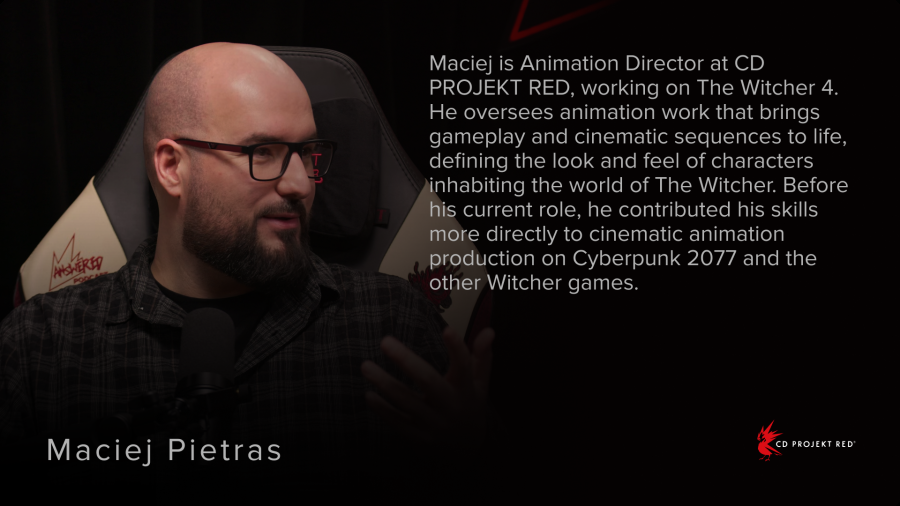
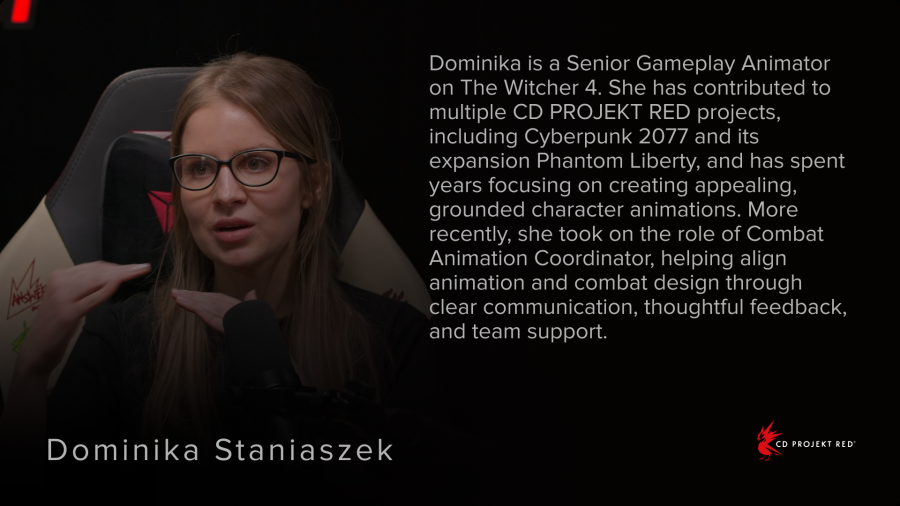
![Growing the Vision: Boston and the Future of Cyberpunk [Transcript Included]](https://common.cdn.cdpr.app/cdpr/news/main/e3b89550d6f3b3b1e3db49d70c5c351d_q90_1280x720.jpeg)
![Beyond the Feed: Community and Social Media [Transcript Included]](https://common.cdn.cdpr.app/cdpr/news/main/94ac2489f40cd24d3f49f3c55710bb39_q90_423x238.png)
![People and Purpose: Shaping Studio Culture [Transcript Included]](https://common.cdn.cdpr.app/cdpr/news/main/03c393163707ede7eb317faf34c397d7_q90_423x238.png)