AnsweRED Podcast Episode 25 — Beyond the Concept: Giving Life to Characters and Monsters
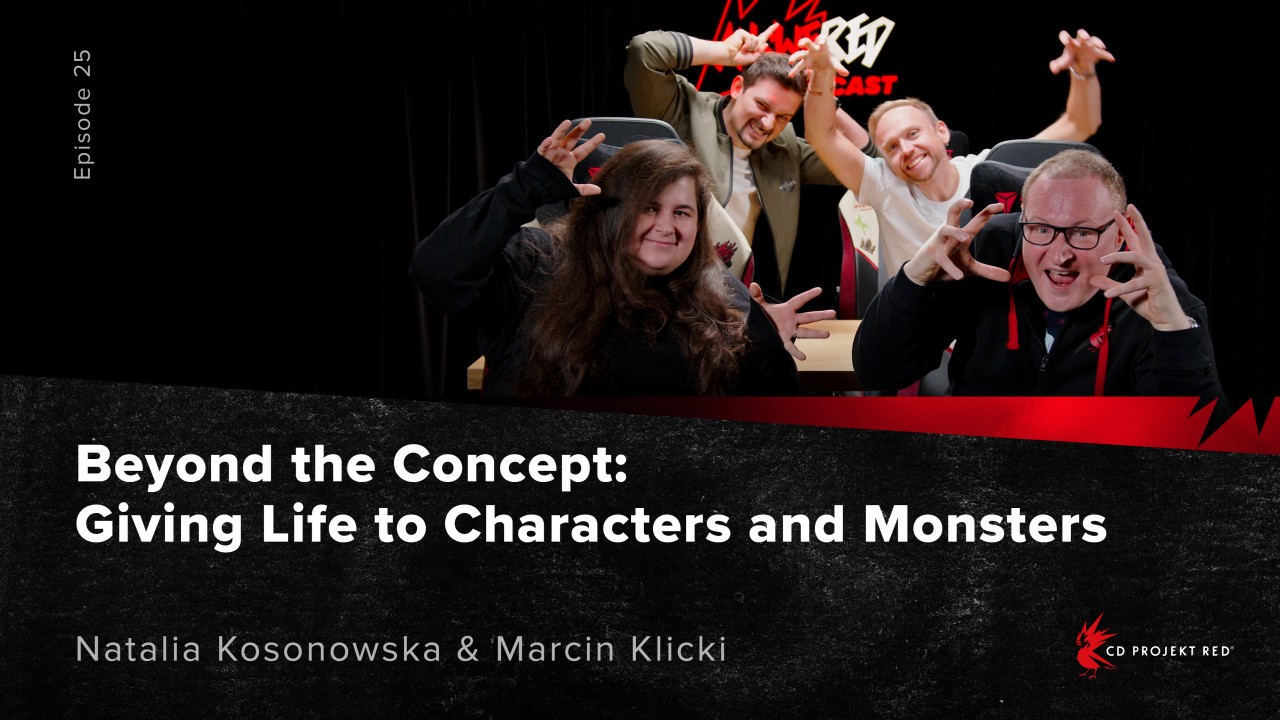
The new year brings a brand-new episode of AnsweRED Podcast, now with a new duo at the helm: joining long-time host Paweł Burza is Paweł Mielniczuk, Art Director of CD PROJEKT RED’s first original IP, Project Hadar!
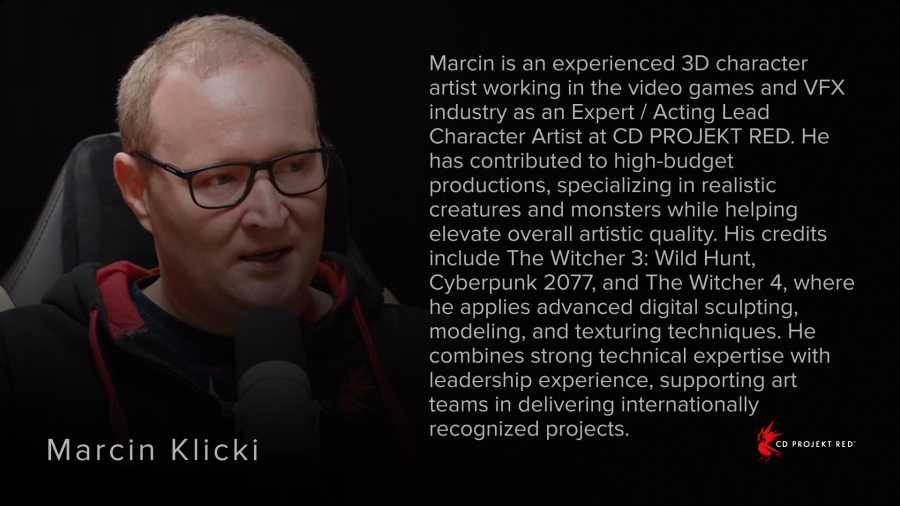
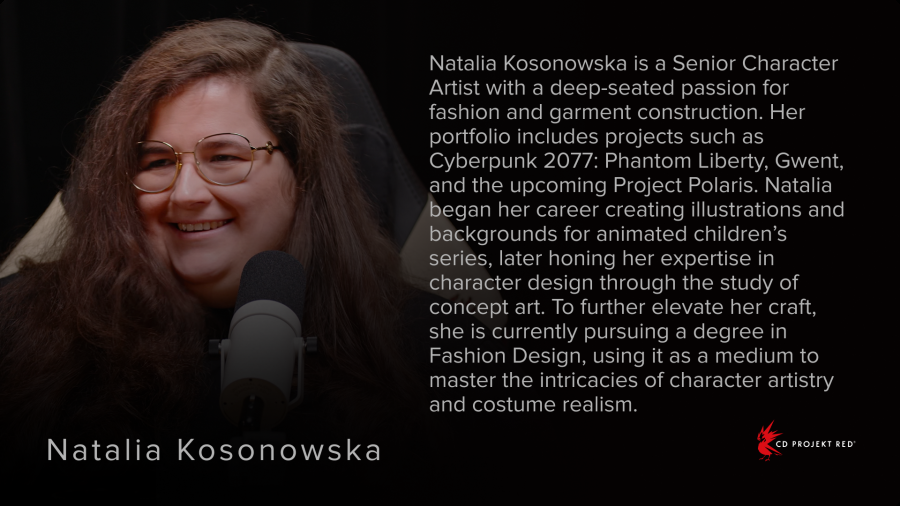
For Episode 25, they are joined by Natalia Kosonowska, Senior Character Artist, and Marcin Klicki, Expert Monster Coordinator, who work to populate the open worlds of our games with believable characters and monsters. Together they shed light on the process, detailing everything from first sketch to in-engine implementation.
Tune in to find out about:
- The relationship between character artists and cosplayers
- Creating stories for characters through clothing
- How aspiring artists should prepare to work in their dream companies
- The importance of believability for monsters
Every person or creature in a video game is created in service of the story, from their anatomy and silhouettes to the materials their clothes are made from. Being able to translate the big-picture story and its themes into a visual language is an important element of character and monster design, and something that both Marcin and Natalia were happy to share their perspectives on.
Alongside an in-depth chat into their jobs, our two guests also shared a healthy dose of advice for aspiring artists: how to position your career to join the studios you’re interested in, and the steps necessary to make your own growth possible. Tune in to hear what they had to say!
Click here to reveal the full transcript.
This transcript has been lightly edited for clarity.
Paweł B: Hello and welcome to the AnsweRED podcast. My name is Paweł Burza and I am joined for the very first time, but actually for the fourth time by Paweł Mielniczuk, my new co-host. You're the Art Director for Project Hadar. I think that's the most important thing, but we have a brand new episode coming up. It's about art, of course. So tell me, who are our guests?
Paweł M: First of all, thank you very much. I'm super happy to be here. I'm aware of how big the shoes are to fill in after Sebastian. I'll do my best. So today our guests are Natalia Kosonowska, a Senior Character Artist, and Marcin Klicki, Expert Monster Coordinator at The Witcher 4 project.
Paweł B: It's going to be an incredible episode, we're going to talk about monsters. We're going to talk about characters, but we're also going to talk a little bit about fashion. And it's going to be an interesting episode. Can't wait. Let's jump straight into it. All right. Natalia, Marcin, welcome to the podcast.
Natalia: Hello. Thank you for the invitation.
Paweł B: It's awesome to have you guys. Could you introduce yourselves a little bit, especially for people who are listening to the podcast and not watching it so they can hear your voice? Maybe tell us something cool about yourself?
Natalia: Hi, I'm Natalia. I'm a character artist.
Marcin: And hello, I'm Marcin. I'm an expert monster artist, let's say, dash character artist. I love monsters, basically.
Paweł B: Beautiful. When I think about you, that's the first thing I associate you with. With all the cool monsters that you did for Witcher 3, but also not only for Witcher 3.
Marcin: Thank you.
Paweł B: Let's start with the questions. Paweł, you have the first one.
Paweł M: Natalia, let's start from you, maybe. I know that you joined CDPR as an illustrator working on Gwent. So what made you decide to move from illustration to character art?
Natalia: Actually, I just joined as an intern, like a 3D intern. But my background was in illustration, and it was quite a big jump, to be honest, because previously I worked in animation studios and we were preparing cartoons for kids. And then the next day my art director said, could you just add a little bit of blood here and there? And it was like a completely different reality for me. But you know, in time, when I developed my skills in concept art, illustration, ZBrush was introduced and I just moved to 3D as a final form of, you know, showing the story of the character.
Paweł B: I remember looking through your portfolio, I saw that you also did a lot of cool clothing for Journeys that we had in GWENT, which was the equivalent of a battle pass, let's say. But then you also did some of the illustrations for some of the characters, also some of the, I think, like monsters and also pets and stuff like that. So there was a mixed bag of things that you did on the project.
Natalia: Yeah, and it was quite challenging because, you know, Witcher world contains knowledge about historical garments. And for example, in future projects like Cyberpunk it's completely opposite. You need to jump to the future and think about how it would be constructed or what kind of materials would be best for this kind of future clothing.
Paweł B: Mhm.
Paweł M: So maybe tell us, what is the core of what character artists do in the studio, in the pipeline? So people understand.
Natalia: For me, it was always like, you know, showing the story without telling it. For example, you have the character. And by even the silhouette of the character, the garments, the dirt on the garments, the haircut, you can tell the story of the character without introducing it by words. And it's on so many levels. You have the tools to just introduce this person, monster or, you know, animal.
Paweł B: What about you, Marcin? Because you are, at least for me, you're a veteran when it comes to monster design, and you're well known, you've appeared in many videos that we did as a studio. So tell me how you kind of started off and how has kind of taken you into the direction of creating some of the most iconic monsters in Witcher, at least for me?
Marcin: So basically, at the beginning, it's always the same path, right? First you want to learn the craft, right? And when you are mastering the craft, you are also meeting different people in different places. Of course, right? So for example, I met Paweł at some kind of small forum, 3D forum, right? It's called max3D.pl. And we met there. And everyone was learning from each other, right? So and of course, years were passing. I was doing different things. I went to different companies. I was doing movies. I was doing some adverts, I was doing many different things. But always at the back of the head, I was like, I really wanted to do the characters. And I met one guy at Platige, and he told me that there is like opening, a slot in CDPR and I just went back home and sent my CV, went to an interview and got hired. I started to do the characters at the beginning. Do you remember?
And then at some review, Paweł told me, like, you should do monsters. And I was like, I like monsters. To be honest, it's really cool work you can do for a living, right? And I started to do more and more and more and, and Paweł was actually giving me more and more and more. And because of that, I made like, maybe not most monsters, but I did quite a lot for The Witcher 3.
Paweł B: Are there any that stand out for you?
Marcin: Yeah, yeah. For sure. I love many of them. My favorite is the Toad Prince because it's the most, it's the—
Paweł M: Legendary.
Marcin: Legendary? Yeah. It was the most difficult monster to do. Even if the character doesn't look like it's most difficult to do that. There are many things that were going on underneath. But I also like the witches. The forest witches.
Paweł B: The famous crones.
Marcin: Yeah, exactly. Exactly. They were fantastic. And maybe troll because he's stupid, but also a bit...
Natalia: Likable.
Paweł M: Became an icon of the GWENT game, right?
Paweł B: Yeah. Shupe the troll and the other trolls were iconic in GWENT. So I have to kind of compare like, character art versus creature monster. Uh, like creating these two. What's the biggest difference apart of course from appearance. Like working in 3D, working on a monster. How well do you need to know, like creature anatomy and stuff like that?
Marcin: Do you want to go deeper into that, that technical stuff, or we want to just talk about, like, briefly?
Paweł B: No, I mean, whatever floats your boat.
Marcin: Okay. [laughter] In my opinion, it’s totally different work from my perspective, right? Uh, especially for a huge project like Witcher 3 or Cyberpunk. Or Cyberpunk is a totally different story, totally different because we shifted more into the, like, gameplay driven designs. But in Witcher 3... Uh... Witcher 3 is Witcher 3. But let's go back to what is different because I like to go to different places. So for that, this is how my brain works. Like, sorry. But anyways, it's a totally different story because you need to first um... Of course you need to get the brief more or less what gameplay needs, right? But at the same time, you have nothing to work, you have nothing to base your work on. Okay, so every monster starts from the beginning, right? You need to develop the skeleton. You need to develop the movement. You need to develop everything, you need to go, you need to record the mocap. You need to do everything right. So it's, uh, it's taking a bit longer to do. And right now it's even more complicated because, like, we are shifting, like CDPR is shifting more into the gameplay driven. So when we are making monsters, we are basically creating a bunch of different blockouts, right? Like, of course we are starting from the concept, right? People, art directors, are accepting the concept or not. But then we are always, like Paweł was teaching us we are always treating the concepts as an inspiration. It's not something like we as a 3D artist, we don't want to be 3D printers, you know. So what we want to do, we also want to add something from ourselves. And I really like it here that we can actually do it. So yeah, we are getting the concept, then we are doing the blockout, we are testing the blockouts in the game, and then guys from the gameplay are actually building the gameplay, and then directors are meeting and talking about this. So it's not like one month of work anymore. It's like more than two, three, four, six months even sometimes. So it's like a lot of work that you need to do. And for character art, it's slightly different because you already have base skeletons, for example, right? You have base meshes. So you are taking this, you are building your character and you can already see it in the idle pose, right? And for example, for many months we don't see idle poses, right? Or maybe not months. Weeks, sorry. We don't see the idle pose. So basically we are blocking it out and we only see it standing still, right?
Paweł M: With monsters there's an iterative process. You're multiplying multiple times, changing depending on the gameplay requirements. We'll see in the engine what works and then what we have to change. So this is slightly different with characters I guess, right Natalia?
Natalia: I remember when I tried to do the monster as an exercise and I received feedback. “There is no way that it's going, you know, it will step forward, like the skeleton is completely not supporting this kind of, you know, mass, ain't no way.” And so yeah, it's way easier if you already have human proportions prepared and you're just preparing the clothes, garments and all the props and attributes.
Paweł M: And how much creative freedom do you have as a character artist working with concept art?
Natalia: I really like what you said about being a 3D printer because I noticed, like, of course it's not groundbreaking, like the best models, which I did. It was an iterating process with close cooperation with the concept artist. Like I remember, for example, working in expansion for Cyberpunk, we had a really close cooperation with the concept artist, and we pushed forward the starting concept from a different perspective. And also, you know, the technical, let's say perspective too, because some concepts are not doable in some arrangement, let's say, because of the technical limitations. So.
Paweł B: You have a specific example of a thing you were working on for Phantom Liberty?
Natalia: Uh, yeah. Actually, I have one story because it's quite funny, the original concept for Lizzie Wizzy in expansion. I noticed some, you know, features which might be concerning in let's say big movements. Some simulation was needed, and I remember I just did the research. What is the idea for the concert? And, no worries, it's going to be static, no big movement, you know, like, oh okay. Okay, then fine. Easy. And then after one month I was just talking and trying to multitask. So I was talking in a huddle and someone gave me an update and I was like, you know, typing. And then I listened: "And then gigantic spider," and I was like, wait, what? And in the end, she was just doing like 360 in the air.
Paweł M: She was kidnapped by the spider and put into a net in the air.
Natalia: Yes, yeah. [laughter]
Paweł B: Not moving at all.
Natalia: Yeah.
Paweł M: Totally static.
Natalia: So this example just shows how we know the project is evolving. And also you need to think about character in a wider perspective because, there are a lot of situations like, okay, let's make a pretty dress, but then she's just running through corridors fighting with bad guys, and the dress might, you know, be torn. And you also need to prepare the additional appearances for this character. Right?
Marcin: But yeah, regarding what you said with, like, close cooperation with the concept artist, it's in my opinion, it's always the best way to actually work. It's giving, like it's pure pleasure to work to work like that. You are doing something, you are getting feedback. Especially if you really trust that other person, that's the best thing that you can actually do. I really like—
Paweł M: I guess the communication here is the key, right?
Marcin: It's the key. Absolutely. Yeah for sure.
Paweł M: So not only have to be like, you know, this perfect modeler, a person who really knows anatomy and knows his craft. But also you need to be very open for collaboration and discussion, talking with probably not only concept artists, but later, like you said, with monsters, with animators, gameplay designers. So I guess with monsters even less known at the beginning, there is a concept as inspiration. Then there is a block of the model, but you never know how the gameplay will evolve. What kind of finishers will be needed? Special attacks. If that's a boss fight, that's a totally different story. [laughter]
Marcin: And sometimes it is like that, you know, you have like the perfect brief. People from the gameplay, they thought about everything, right? And you created exactly what they wanted. But they are putting this in the game.
Paweł M: It doesn't work.
Marcin: And it doesn't work. Exactly. And you really love the output, right? And you were like, oh my God. And you need to change almost everything. Like sometimes it is heartbreaking. I need to, need to say it. But yeah, at the end we are doing the game. So yeah changes are normal right.
Paweł B: You also see kind of the complexity of some of the characters. Like I still am in awe although we already showed the Bauk, for example. So we showed them in the trailer. But I'm in awe of how many creatures actually go into one big creature, right? Like he moves like a dinosaur, kind of. But then he can be on, you know, can be moving like a spider, can be walking on freaking walls and then can be, you know, attacking you with the pincer arms and stuff like that, all that stuff that there's so many things that go into that. It's crazy, but you take it for granted if you think about it because you're like, oh, it's a cool monster, but that monster has so much like stuff connected to it and the way it moves and inspirations that come from, like for the movement that come from like, real animals is crazy, right? So I've always been in awe of these things.
Paweł M: What are the inspirations for monsters, Marcin? Share with us.
Paweł B: You said you have a dog, so you probably also like, see how you know, dogs walk because they walk differently than we do.
Marcin: For sure. Like, even when we were doing the wolf for the game, like I was going downstairs and I was doing the pictures of my dog and I was like, sending it to the guy that was doing the fur just to give him a hint. And it's not looking like that. It should go more like this, more triangle. Take a look at my dog. It's not even close to the wolf. But you know what I mean. Right? Uh, yeah, but the inspirations, like I would say, you know, it's different. It's kind of different every year that you do this kind of stuff because it's normal that you need to create the library in your head. So you are looking at different things. Sometimes it's gore, right? On Google, right. Because you need to do some nasty things, right? But other than this of course for many hours I just sit there on Pinterest and I'm like trying to see what people do. Artstation also, right? You need to feed your brain with what the direction is — because it's changing from year to year. The direction is actually slightly shifting, right? So for example, zombie that was scary for you ten years ago. Right now it's funny. So you need to like slightly be constantly feeding your brain with really, really strange pictures. And sometimes it's I don't know, you are walking in the forest and you see like, uh, a strange mushroom and you are like, boom! That would be like, a cool base for the monster, right? Sometimes it's just like when I have nothing in my head and it's pretty much all the time. [laughter]
Paweł B: Yeah, right.
Marcin: I'm just opening ZBrush, and I'm trying to bash something. Right. And I noticed that in many cases, like when you are trying to figure it out, figure out something and you have nothing in your head like you are just doing...
Paweł B: Blank slate.
Marcin: Exactly. You're doing some random stuff, right? But the next day you are coming back and you are like reviewing your stuff. And sometimes you need to challenge yourself. And just like, okay, I'm picking this guy. I will try to push him in some, I don't know, scary direction, maybe creature direction, maybe more human direction. There are a lot of things that you can do, right? And yeah, I'm trying to, right now I'm in the place where I'm trying to design more my stuff, but it doesn't mean that nothing is actually influencing me, right? Because I talked with my friends and they are like saying, no, no, no, you are picking something from Pinterest. So it's already not your idea. Like, yes, but you're always getting inspired by many different things. Sometimes you just see part of the model that was created by different artists, and you like this part of that model so much that you want to have it on your own stuff like...
Paweł M: Or it becomes the main motif of the—
Marcin: Exactly, exactly. And I have this many, many times like I just like some small part. And this is actually changing to the whole character.
Paweł M: Yeah, I think the big part of it is just, you know, it's not copying, it's just reinterpreting, inventing something new. You know, everything was done already, right? From the old masters. Everybody's copying old masters all the time, you know, and it's just. But we are reinterpreting, adding something new, trying to show it from a different perspective, different angle. And that's, you know, that's a creative process.
Marcin: Uh, I don't know if I can say it, but for example, the Bauk was created from one small concept that this guy was hidden behind the trees, and you only see a couple of arms and the head and nothing more. And the guy actually, you know, working, of course, he was working with the concept artist, but he created the whole piece from one shot. That our art director really liked. He was like constantly coming up to our department. And he was like saying, I want this, I want this guy. And we were like, this isn't a concept even.
Paweł B: We gotta start somewhere, right?
Marcin: Yeah.
Paweł B: Natalia, I want to kind of touch on clothing and fashion because I know this is something that you're very well versed in. Um, so what about the looks for Cyberpunk? They were already defined. Like, I remember we used to have in in the studio, these posters with the styles that you can kind of expect that, you know, if you're someone in Night City who is trying to pretty much work 9 to 5 trying to make scratch and then you're kind of utilizing things that can be used as, let's say, recycled electronic garbage and then kind of, you know, enhance yourself with it. And then we also had the luxury, like corpos, who had the best cars, they had the neokitsch stuff, all that, all that jazz. So how much of like, real fashion plays into, you know, creating the way a character looks and how he or she is dressed?
Natalia: Yeah. Right now I'm just trying to, you know, learn about fashion construction. And it's a really broad topic, but we always aim to just create the clothing, which is easy to prepare in real life. For example, some cosplayer might want to just cosplay a character and it needs to be constructed and concepted in a way that is doable, right? And it's also comfortable, and it makes sense. So that's the one thing. The other thing is if you create a character for some, I don't know, group like you mentioned the styles, but you also can think about the groups, like poor people, people with their addictions or some business guys, they need to be like, from the first sight. It should be clear visually that this guy has a problem. This guy is homeless or like, the character should be grounded. Like it would not look natural if you have a super clean guy in a completely devastated building with graffiti on the walls. So it's like on many levels, like from the construction point to the condition of the clothing and also the styles as, as you mentioned, because it's like the full story, the full storytelling, let's say.
Paweł M: And does it often happen that you're adding some Easter eggs, you know, some extra details that are not on the concept? Maybe nobody knows about them, but it's your personal touch, you know, adding to the storytelling of the character.
Natalia: I know that some artists do, some hidden in [laughs]
Paweł M: It's risky business.
Natalia: Yes. [laughter] Yeah, but I did not. I did not, but I know it's happening. Like a lot of those Easter eggs you can find in GWENT cards, illustrations, for example. Like a lot of them.
Paweł M: Remember, once there was some kind of I think it was an inscription on a sword in The Witcher 3. That was like in Glagolithic or some kind, like saying hi to my friends or something like that.
Natalia: Yeah, I remember once the writer just reached me out because I was preparing the 3D version for the card and he said, is it on purpose or is it a part of storytelling because he noticed it. I said, please contact the illustration guy, he will be the best place of information.
Paweł B: Wasn't me.
Natalia: I'm only just doing, you know, the 3D card. So it was quite, quite funny. But we also always ask the question, is it on purpose? Is it historic or is it just supposed to be there?
Paweł B: But adds a personal touch to the whole thing. And I also like what you mentioned about when creating clothing that they need to be grounded and believable. And I think that's always, I remember when I joined the company working in the Community team, we would get contacted by cosplayers and would actually do cosplay guides for them with proper 3D models of the characters. And the feedback that we always got is that, wow, these are actually things that I can make. And they're not just things that, you know, don't go together because they of course, have, you know, a broad range of cosplays that they do. And they said that, you know, some cosplays, we try to do them, but it's super difficult because in real life these things don't really go and gel together. So they need to think about how to construct some of the things so they actually are, you know, something that they can put on themselves and wear. So I think that's always super important to have.
Natalia: One example about, you know, getting inspiration, because one of the exercises in my studies was like, just fold the paper and create the full, you know, dress, like evening dress, from it. And I remember I just took a photo and, "how I'm supposed to do the dress from folded paper?" But then I saw, you know, shades like lights and I saw forms. And in the end, I just created this concept for a dress, but still, after, you know, the first quick concept is like, where are the seams, Natalia? I was like, hmm.
Paweł B: Good question.
Natalia: Yeah. Good question. Uh, so, yeah. So the construction is super important.
Paweł M: You said, because in your pipeline, apart from ZBrush, you're also using Marvelous Designer. So this is a tool actually created for fashion designers first. And then it was adapted by gaming and I think the movie industry. And you actually are doing like real patterns and like a tailor sewing them together and making garments. So that's—
Natalia: Yeah. And also when I was working in Marvelous, I just realized I have no idea how the medieval pattern was working. And when I did the research, it was completely different. It was way more, let's say not intuitive, but multi-purpose. For example, pregnant women had one, you know, let's say an apron and they just changed the size by, you know, the string. It wasn't like, some concepts were more practical because of the lack of resources. So yeah. And also the pattern cutting was completely different in many cases.
Paweł M: But it's like, you know, you have to master a very traditional skill actually to be proficient right now with making digital characters. And it's actually with monsters the same, like sculpting in clay, for example. Is it something that's useful for an artist?
Marcin: Definitely. Like every skill, like traditional skill is fully transferable for the design, for the sculpting, the character, for everything. So for example, when somebody new is coming to our team and we were hiring like junior, mid artists, right a couple years ago. I always like trying to convince that guy that he should at least learn the basics of the drawing. It's super important. Like, uh, you need to understand the light to be able to sculpt really well, right? And, of course, it's not about, like, creating ultra realistic humans 1 to 1, because once you see the guy and you are capable to print them on the paper. It's not like that. Like, but super lame doodles, right? But you can add a bit of shading on that guy. And this is changing, in my opinion, everything, right? Because this is actually giving you understanding of the main forms. And the main forms are the most important. So the rest you will learn in the process. But of course, if we are talking about more technical stuff, I always have this tendency and I believe that you also have had it. So we are looking more at the artistic side of the people that are actually trying to get in CD PROJEKT, right? Then the technical stuff. Because you can learn the technical stuff in exactly like half a year and you know everything, right? Because you have seniors, you have experts, they will give you a lot of feedback even if you don't want that feedback.
Paweł B: I also love this about CD PROJEKT. I also saw it when we were working on GWENT. I saw that you have this like tradition or just a sync that everybody is pretty much on. And the thing that I love the most is choosing concepts for cards, which would later become like the card. But it's incredible to see how many options you have from concepts. Let's say we're working on one thing, and then you have 4 to 5 different concepts, and then you choose one, and then you iterate and you iterate on it together, which I like the collective feedback. Let's say that someone of course, it must be super stressful as an artist to like come with something and say, okay, this is mine. Now critique the hell out of it. But I think, like you guys said, it makes you better. You're learning from other people. There are people who are seniors, who are juniors, who are in the room, who are also like, you know, learning and also giving their feedback, different perspectives. And thanks to this, it makes the whole thing even better. So you're like uplifting one another, although it might be also stressful like in the moment of it. But that's always something that stood out for me. And I think it's super cool.
Natalia: That reminds me of one thing. When I was on exchange in Wales, uh, I was like, I used to feedback in Poland. I think we used to focus on the bad things, which could be improved. And then we just put a like, great job. I mean, just put the, you did this nice. But first we focus on the stuff which is to be fixed or our personal—
Paweł B: The negatives.
Natalia: Yes.
Marcin: Because we are Polish. First negatives and then, "Good work."
Paweł B: This is terrible. This is terrible. This is terrible. But good job.
Natalia: Yeah. And I— And I was in Wales and I didn't know that the United Kingdom way of feedback in this otherwise like you first focus on, you know, like positive stuff.
Paweł B: Compliment sandwich. Good, bad, good. So you put it together.
Paweł M: Exactly.
Natalia: And I was on my classes and I just went straight forward. Oh, I will just fix that and this and everyone was completely silent because, like, complete silence. And then I learned there is way more. A lot of ways of feedbacking. So yeah, it might be stressful, but of course, it's like I was fortunate that I have the teams and leads which like to teach you something. Also, and—
Marcin: Most important part is to be open minded, and I think like when you are getting better, right. You want to do more by like, your own way of doing it. So sometimes you are at this point before you will level up that you are actually thinking that, okay, I'm already at the moment that I don't need to get too much feedback. I want to do my own stuff, right? But it's super important to be open minded. Yeah for the feedback, even if sometimes it hurts your ego. It hurts. Trust me. It hurts sometimes, right? But you know, at the end you will always say no, but just give yourself 2 or 3 minutes. Think about it. And then, you know, try to look at it from a different angle, because it is sometimes hard to be feedbacked, to be honest. It's not easy.
Paweł M: I think it's both ways. Taking feedback is something you have to learn. But also giving feedback is something you have to learn, right? I think it's in RED especially. It's very important for us to have this feedback culture. So first of all, everybody can feedback, right? But it needs to be constructive. You need to be really precise. If you don't like it, tell me exactly what was the problem. Not just to bash something and say, oh, just throw it out because that's my opinion, you know? So actually, how do you learn that? What's the process of learning feedback? Because I know how hard it is.
Marcin: I don't know, from you maybe? You were a lead. You were my lead for, like, many years, I believe. So, yeah, you had, like, a lot of—
Paweł M: Happy to help. Thank you.
Marcin: Because, like, at the beginning. I had the same kind of approach that you had. Yeah, I'm only focusing on the bad things and good things? We are not talking about like good things, okay, you know those things. are good. [laughter] Yeah. But at the end it's not helping anyone unfortunately. Because like, actually, you know what? There is an additional thing that also is super important. To know when somebody is actually achieving his top skill at the moment. Because like you can give an artist additional feedback, but at some point you should see that, okay, he's not making progress, so you should stop. And I believe that a lot of people don't have this skill, right. They think that if I say something right, automatically this guy will learn. Okay, I said it. So this guy already has the skill, right? But unfortunately, it doesn't work like that. So sometimes if an artist actually looks at it, I will actually watch it. So I believe that most of you guys have this kind of thing that your brain is ahead of your hand. Do you know what I mean? So you see that you should be better, but your stuff is not as good as you imagined. But this is exactly, like this is before you will level up, right? A lot of people like misleading this, and they think they should quit because we don't know what is happening, right? But you just need to give yourself time and just do the stuff. But yeah, at the end, when you are also giving the feedback, it's super important just to know that, okay, this guy has enough. This is good for the game. We don't need to push it. It's not, it doesn't need to be perfect. It's good as it is. So it's fine. Uh.... Yeah.
Natalia: I would add something to that. Like trust the process. Trust the process. Because I have a graveyard of unfinished characters. And what is in my opinion, the most important to just finalize them, even if they are not, you know, the best of stuff, which you have in mind, like finalization of the character, even for personal projects, it will just push you forward.
Marcin: I so agree with that. You don't even know. Yeah, I so agree. But still it's so hard to finish them.
Natalia: Yes. That's why I mentioned I have a graveyard. You know, a lot of them. Like just looking at me and like, where is my time?
Paweł B: Where's my time to shine?
Natalia: Yes. Yeah.
Marcin: But you know, at the end there is even from those fails because like, if you didn't finalize the character it is okay, maybe not a failure, but—
Natalia: You did something.
Marcin: You did something, you learned something. But also the failure is that you let it go. But the most important part is to actually look at the bright side. So what I actually managed to learn from that. And I had many models that I did at home and most of them I never finished, but I learned some new technique, and I was able to actually put those things that I learned on the characters that I did for The Witcher 3.
Paweł M: I think it's important to say, actually, how long it takes to make a character because it requires persistence, actually. What's the timing of making a character and monster? How much time? You said like four months for full iteration, but making like, let's say there's no iteration. It's from A to Z. How much time does it take to complete a character and monster?
Natalia: I don't think there is a one, you know, timeline. For example, you have a super complex character with a lot of attributes, backpack or whatever, like a lot of props. And each of these props is just a 3D model, right. And on the other hand, you can have a simple concept with, you know, only some plain dress or something like that, but it's not like, the time is in preparing also the model which is working in the engine. So preparing optimized character, which actually can be rigged and like moved in, worked in animation. So it's not only like, yeah, I just did an awesome character in ZBrush and that's it, right?
Paweł M: So it's like 30 days, 40 days?
Natalia: Okay, so.
Paweł M: Give us a number.
Natalia: Like looking at my previous experience. It's always more than one month to be honest. It depends really. It depends.
Paweł M: There's so many times— I had this myself actually, that when I was making characters that, you know, the first part of the process is fun. You're sculpting, you're creating stuff. But then the second part is this technical process. You're making low poly, unwrapping, texturing, putting to engine. And I saw so many artists just being overburdened over a period of one task, you know? So what's the hardest for you, maybe? What do you like and what was the hardest part of the process for you?
Paweł B: What you dislike.
Paweł M: Yeah.
Marcin: So for the monster, I will go quickly to the previous question. For the monster we are having like at least a month. And in most of the cases, it's like two months of developing the character. I'm only talking about the sculpting, the changing and doing details, right, and stuff like that.
Paweł M: Without this whole process later of adapting to gameplay.
Marcin: Yeah, exactly.
Paweł M: Just pure process.
Marcin: Because the iterations will give additional time, right? Because we also need to have time to fix those things, to change and stuff like that. The next question that you already asked, and it's a really good one, right? Because I noticed that this is actually changing when you are like doing the character art for many years. So at the beginning, I was like, I was having exactly what you said. I love sculpting. The rest is, [tsks] eh. Right? Right now the best part is actually putting the character in the engine, creating textures, materials, and you are seeing the final outcome and you are like, okay. This is cool, I like it.
Paweł M: Is it because of Unreal Engine? Because, like, I remember in The Witcher, it was physically impossible, I guess, to put it into the engine during the production. [chuckles]
Marcin: Sometimes. [laughter] Sometimes we could do that. Right? But yeah. Yeah, it's also because of the Unreal Engine, right? It's super intuitive right now. But yeah, like it's actually changing, as I told you. And also, you know, this technical stuff is getting easier right now. A bit easier, Unreal, you know, we are going into the direction that, uh, the low polys you don't need to have perfect low poly anymore.
Paweł M: It's not so restricted anymore.
Marcin: Yeah. So it's giving you just a bit more wiggle room, right. Just to, you know, to smooth the corners, [laughter] let's say.
Paweł B: Nice. You both spoke about iteration. When does iteration stop? Because we know that we love iterating and you guys are all here artists, and you could iterate for a long, long time. Where do you say you're like, okay, it's time to put everything down and say, okay, I'm done with this. This is where I have to. Because of course, game dev is a process. We have a whole production team. We have milestones that we need to hit. We have submissions that we need to do in order for things to actually go and move, proceed forward. Do you feel like this is sometimes constricting you in terms of, like what you can do in the artistic way, or do you feel like, okay, there is a moment where I'm happy with this. It can go, I can move on to the next thing.
Natalia: Um, I think it depends on the person, really, because I know people who are just super experienced and they just did thousands of the models and they know, what is like, okay, that's the time to stop. It's enough. It's not going to be visible. It's okay. Let's ship it. But also I have met some illustrators or for example, our key visuals, which all the time want to push forward the artwork and every time I have one situation in my mind when one of the artists, every time I can fix this area, it will be better. And every time it was better. Like, you can't even argue with him because every time it was better. But then our director just came and said, okay, it's already a masterpiece. It's even more than I expected. It's beautiful. Let's ship it. And I feel like the role of the art director is super important for cases like with the perfectionist, perfectionism all the time aiming for, you know, best results. But some of the artists just, like, now has different perspectives.
Marcin: Yeah. Like I have differently a bit. It depends if I'm attached to the character or not. If I'm attached I don't know when to say stop. Like it's hard to say that this is enough. But sometimes when you are doing the proper something, then it's you. You exactly know when to say stop.
Paweł M: The faster, the better. You know, with ZBrush, it's this process that you have a low poly blob. First you have detailed, then you divide it. You do the whole creature again, then you divide it again, you know, and add more layers of details. And you can never actually stop, you know? And like you said, the engines are getting more and more efficient. You know, you can put more topology, more textures. So it's really yeah, I would say a game is never finished. You cannot finish a game. You can patch it forever. You know, you can keep it in development for 10 years. There's always something you can still fix. So it's really, yeah. It's a difficult skill to say done. Stop. Good enough.
Natalia: It's like a living creature all the time. Like a project is a completely living creature.
Marcin: And of course you want to do the best that you can, right? And of course, sometimes, you know, you just can't achieve what you have in your head. And yeah, you are trying.
Paweł M: Also one aspect of this is that, you know, the development of the game takes like, between, let's say, 4 to 6 years, depending on the project. And this a lot of time. And you have an artist for five years making stuff for the game. Naturally everyone becomes better and every next model is better. You're learning with, you know, while flowing with the go. I remember it happened that we made some, for example, for a demo, a main character at the beginning of the process. And then three years later you're releasing the game, and this character is the worst from all of them. And there's a dilemma. Should we do it from scratch? It doesn't age well, so deferring and putting to the end of the pipeline, you know, the most important characters is one of the things I was doing usually.
Marcin: Yeah. That's super important, right? And of course, if you have power. Because some people are actually going back to the old models and they are like slightly at least on the textures and materials they are trying—
Paweł M: Officially? Or unofficially?
Marcin: Unofficially.
Paweł M: Does production know about it? [laughter]
Marcin: Sometimes you can just, you know, slide one hour here, one hour there. Yeah.
Paweł B: So what would you say is your favorite thing of the craft and the thing you kind are like, eh, that's something that I don't enjoy as much. Like overall in your day to day.
Marcin: Yeah. Okay. So I can start. So for me it's definitely the design process. It's the hardest but the best thing that you can do actually.
Paweł B: Okay. And the worst?
Marcin: UVs.
Paweł B: UVs? Yes.
Marcin: Like, I don't understand. Like we have the age of the AI and nobody is creating the AI for UVs. Why?
Paweł M: They're making everything they shouldn't, but they cannot make low poly and UVs. Like. What's wrong?
Marcin: What the hell?
Paweł B: Interesting.
Paweł M: Same for you.
Natalia: I think for me, it's like, you know, the process of detailing the high poly is like putting the small, like putting the soul into the sculpt and the garments itself and all the finishing, like, making it super pretty. Yeah. So for sure. And the least, hm, that's a tough question. Maybe, like happy little accidents, like hello, I just corrupted your file, Like, you know, technical technical...
Paweł B: Technical problems.
Natalia: Technical problems. Because for now, sometimes I feel like in this like retopo, I quite like retopo because it's like the moment of, you know, catching a breath, let's say, for me, it's not super, in my opinion, of course creative process. So it's like a moment of, you know, pass. And then the texturing is also like more, you know, more freedom in it, in my opinion.
Marcin: In our department, we are saying that this is like a hangover job. [laughter]
Natalia: Okay.
Paweł M: Brainless. No, but you know, for you it's easy, the retopo. But for younger artists, for juniors, you know we are looking at portfolios. It's not so obvious actually how to make a good retopo for the character. It is a skill that you have to, you know, develop craft. But once you know it, then you know. It becomes easy.
Natalia: I was fortunate that my lead was super into showing the best approach to the retopo and it was like a super spike in my development, let's say, like he just spent a lot of time to—
Paweł M: Grzegorz Magiera?
Natalia: Yeah, he spent a lot of time for me and my colleague to just explain the fundamentals of it. And when we, you know, understood, then it was easier to just polish in this area.
Marcin: Yeah, it's. But still, you need to do, like, three, four, five characters just to understand what you are doing bad, right? So you need to do the test bags. So then you see where you are making the mistake. You need to like—
Paweł M: With the normal maps, right?
Marcin: Yeah. Of course.
Natalia: I'm still going back sometimes and fix, okay. It's not the best, just cut.
Marcin: Yeah sure sure. Like sometimes problems happen. Yeah, but this is something that for sure, you need to learn by doing.
Paweł M: I remember now, probably it's not such a big problem. We have Metahuman that's making the topology of the faces. But I remember in The Witcher, the problem was that we had a ZBrush sculpt. So this high resolution sculpture that was, you know, perfect face. And we loved it. And then turning it into a low poly character, you know, without having this far less polygons, triangles, the chains were subtle, but they were completely changing the personality of the character. And that was a struggle, right?
Marcin: Yeah. But actually I like the process. It was pretty fun because it wasn't taking you weeks. And of course, right now you need to understand that those things are so difficult, even with the new tools, that it's taking you a lot of time. You need to have a lot of knowledge and you need to have a lot of time just to push your sculpt through the technical process, right? And in Witcher 3 it was super, super simple, right? We were just putting the bones on the face. We had the texture, where the bones should be. We were putting the bones boom, boom, boom export done. It was working like a charm. Like come on.
Paweł B: Crazy.
Paweł M: I'm weird maybe, because I like UVs. I'm repping UVs.
Natalia: Not judging.
Paweł M: Not judging, sorry. But why? It was like for me, that was this only process in making characters that can be actually done. And there's, you know, I can unwrap it. I take time, you know, and make it beautifully. I don't know how it changed right now because I haven't done unwrapping for like five years at least. But, you know, this is a process I can finish up and it's all perfect. Nothing to be fixed. So I'm happy. Easy results. Dopamine. You know. Success.
Natalia: I think also the closure of the steps are like dopamine shots sometimes like, you know, the feeling that I finalized some, you know, stage.
Marcin: But only finalizing stuff or when you are seeing the model in the game? Because for me, it's more like seeing the model in the game right now. I don't have this dopamine shots anymore.
Natalia: Maybe it comes with the perspective. Perspective changes with the years of experience. Probably. Or it's a personal one. Yeah. But it's like you know, for me, it's like getting closer to the final, like, stage. Right?
Paweł B: Yeah. The finished piece, pretty much. Because that's when, you know, you're totally done.
Natalia: That's true, that's true. Getting closer to the, you know, beautiful character.
Paweł B: Where do you think that you would go back to a character or design that you did and say like, oh, I would totally do this now in a different way? Is there anything that comes to mind?
Natalia: Every time.
Marcin: Oh my God. I was having nightmares after we released The Witcher 3. Right. Uh, like, two weeks later, I was having the wedding. And after the wedding, I was playing the game. So for, like, one week before we went to the honeymoon, I was playing the game, and I was, like, constantly sitting like that, and I couldn't believe that I did something like that. Like why I didn't play the game earlier just so I can fix it. Marcin: But fortunately, I fixed most of the stuff in the patches, right? Because but it was also like the learning process that when you are doing the stuff, you also need to play it because people don't know what you want to achieve, right? So they think that, okay, this arm is broken, probably it should be broken, right? But it shouldn't.
Paweł B: That's what the artist wanted.
Marcin: Exactly, exactly. It was like that. It is like that. And I was like, oh my God. Like I was having nightmares that most of the stuff is not on the level that I would like. Like, I would like to have it right. And I was like asking Paweł, Paweł, when the patch is releasing? And I was like, fixing what I can.
Paweł M: Mysterious submit. [laughter] Oh, it's nothing.
Paweł B: Just a little tweak. Little redesign.
Paweł M: Nothing. Nothing. But you touch on a very important topic here, playing the game, you know, because I very often hear from artists from outside the studio that they don't play the game while developing it because they don't want to spoil the experience for themselves after it's released. What's your take on that?
Natalia: Yeah, I think like, for example, during preparation for expansion for Cyberpunk, it was super important. It was developing super quick. I remember I was doing the crowd and wanted to check how it plays in game, works in-game. And the week before it was, everything was set up. And the next week I ask, where are the guys? Oh, we just deleted them. Oh, okay. Okay, we don't need them. Okay, okay, okay. We will just use them in other contexts because they still could be like representatives of some crowd. So it was like, knowledge about what is happening in the project, where your characters will be used, in what context? It's like all the time like, as I said, living creature, constantly changing. And also, you know, as some things are developing, new ideas come and sometimes some characters need more appearances for I don't know, more clothes or less clothes. So, you need to be aware about your, you know, context, your character, or you are like an owner of this little guy. And you need to make sure that he will have clothes when it's needed.
Marcin: I believe that in CDPR we have a different kind of way of working a bit because when you are actually, you are the owner of the character. And when I talk with my friends, in most of the cases, when they are working in different places, they are not, like they are only doing the sculpts and the low poly and UVs and that's it. And different departments are like, you know, taking over the character and they are doing different things. But here we are doing actually 90% of the work, right? So you are doing low poly, high poly, you are exporting this, you are making the materials. You are talking with the guys from the tech how the rig should work and stuff like that. So basically you are responsible for the character until it will end up in the game, right? So...
Paweł M: And further.
Marcin: Yeah. Even further. Exactly. Because for many, many times I was asked by a director of the game to actually come to the room to see what I did. What have you done?
Paweł M: What is it?
Marcin: Fun times. What is it? It's a monster.
Paweł B: What does it do? Well, it does this.
Marcin: Yeah. But anyways, for me, it didn't even spoil anything because, like, you cannot spoil. You cannot spoil the game if you play the game for like, two hours. Come on. It's like, you know, we are doing projects for 100 hours, right? So you would need to play the whole game to actually spoil it. So for me, it's absolutely not a problem. But definitely I recommend everyone just to take a look how your characters are behaving when they are inside of the game. And actually when you play the game.
Paweł M: It's different in ZBrush, different in Photoshop, etc. and different in end game.
Marcin: Yeah, the camera.
Paweł M: Even the mesh editor like entity. Different story.
Marcin: In the mesh editor you have different FOV, you have different camera. You have different lighting, right? And then you are launching the game and you have like totally different characters.
Paweł M: It's a laboratory and that's the real life.
Marcin: Yeah, exactly. Exactly like that. So all the tweaks are needed definitely here and there.
Paweł B: Nice. How does your job look now? Because you're an expert. You're a coordinator, so you're probably passing on knowledge a little bit more than being more, let's say, hands on and creating things. So how does your day to day now look?
Marcin: A bit more meetings.
Paweł B: Mhm.
Marcin: Yeah, a bit more meetings, normally a bit.
Paweł B: But you're an artist, so you have the creative, like you need to be working on things in order for you to also progress your craft, right?
Marcin: So basically, I'm slower than I should be. That's I don't know, this is probably con for someone, but yeah, like I need to do a couple of more things. So first, every Monday we are planning the work for the week. So we have like one meeting. Then we are going, and I need to talk with the director about the things that we did last week. What's the direction, what's the feedback for the people. So I need to get like, I need to just gather the information. And actually this is a huge part of my work right now. So I'm gathering the information and I'm like connecting the people. And I'm trying to push the things forward in the fastest way we can. And of course, I have like, really amazing producer. Łukasz, that is like, helping me a lot with everything. So he's the heavy lifter in that relationship, to be honest, because he's like doing all the managing stuff like meeting here, meeting there.
Paweł M: Jira?
Marcin: Exactly. Exactly. But it's like let's say I'm trying because we are almost ready. We already have a team that is set up for the production. So all the people know what they need to do. So from let's say, because I was like modeling for 30% right now I'm somewhere 60% of my work. And it will get a bit higher, I believe. But yeah, I also have meetings with my people. I'm giving them feedback from the directors also, like, I'm trying to help them out if they have any problems. So... You know, it's sometimes just hard to understand what the director wants. So I'm doing some overpaint if I see that something is really off. Because I'm trying to give my people more like, almost the artistic freedom. So if they have, like, cool ideas. I'm not trying to change it. Only if this will break the gameplay. So then okay, we need to change this. But if they want to add something, it's fine. But also, if I see something that is, like under our level of creating the assets, also I'm intervening. But fortunately right now we have almost a senior team. So I'm like, nice, let's say chilling.
Paweł B: So you still have time to actually work.
Marcin: To do the work.
Paweł M: Has it happened that you're actually sculpting something yourself if someone is not, you know, doing it the right way and you're taking off the model and sculpting yourself, or it's more overpaint or it depends?
Marcin: So it depends on the artist because some people don't like it. Some people just want to see the overpaint and they want to do the work by themselves. And this is very important just to understand people's needs. Because you cannot be the guy that will be like, okay, I will do it better. Give it to me and that's it, right? Because people will get frustrated really quickly. And the artists are really specific people. We know. We know that.
Paweł M: Fragile.
Marcin: Fragile. Exactly. Yeah, exactly. We can laugh, but it is like that, right? If you are an artist, you are fragile in a very, very—
Paweł M: It's caring about your work, you know, like being also deeply involved. What you're doing, you know, it's your craft, your creativity, your passion, your life put into the model. So, yeah, you need to be careful.
Marcin: You need to be really careful. Yeah. But some people like when I see that for example, for two weeks they are like really trying, but they are stuck, right. So then I'm like, okay bro, give it to me. I will just check a couple of things and maybe you should do it in a different way. We had this kind of situation a couple months ago when we changed the design of the character because it didn't support the gameplay. But we wanted to reuse the concept. And it was such a specific concept that the artist who is doing it, he didn't have enough experience to actually think about the process. So he started from the end, actually, and he couldn't achieve the proper outcome, right? Expected outcome. And then like for two weeks, I was like, looking at his struggle and then like, we talked and I was like, telling him, okay, you need to start from a normal human, create a normal human that is underneath this guy that you see on the concept because you need to have structure. What you are not having on that character is the structure that's why nobody likes it, right? Because people just don't know what they are actually seeing, right? Because they don't see where is the bone, where is the stuff. And like next day he actually clicked.
Paweł B: Incredible.
Marcin: It was like one word. Basically.
Paweł M: That's with monsters people are always, even if you are making a crazy monster like human brain is looking for some kind of patterns from real life. It's very sensitive to: it's a humanoid? It needs to have all this. Like all the creatures in nature, they actually have the same skeleton, just deformed in different ways with different proportions. It needs to work correctly.
Marcin: It's super tricky. Exactly like you said. Like there are artists that are breaking this, but you need to be at the end level of the artistic.
Paweł M: Picasso, you know?
Marcin: Exactly. So he went through every step, and then when he mastered everything, he invented his own way. And you can like, okay, you can only say that you like it or not, but you cannot go and I will give you feedback. Feedback for what?
Natalia: Yeah. It was always like magic for me. It still needs to be believable, right? You are just trying to reinvent some way of thinking about a creature but it's still, when you look at it, even some people who are not, you know, just regular like, uh, in movie audience, they still need to feel that it's really a living creature. It's super, super hard. Extremely hard.
Marcin: That's why back in the day, they were like, putting everything in the dark places. But actually, it was working, to be honest, a bit better for the imagination. Right? Because when you see everything, it's not scary anymore.
Natalia: Like Bauk. This small Bauk.
Paweł B: In the corner. Like five pixels. That's what I want. To wrap things up, could you say maybe something for people who are trying to kind of go in the path that you're already on, like, what's the best kind of tip you would give to this person or someone that wants to join us here at CDPR?
Natalia: Okay, so in my case, it was like I was developing what I want to do in my life. I knew I like art, but I was so easy, like everything was interesting for me. Like I want to learn everything. So it was my path when I started, you know, I started with illustration to the fundaments, concept art, and then I knew that I like to tell stories in visual way. And this guy showed me ZBrush.
Marcin: I was actually curious do you remember still?
Natalia: I remember and I was like, oh my God, wow, it rotates. You know, I was like super, super crazy. Uh, and you know, I just was introduced to the ZBrush. I liked it and now I'm learning fashion, you know, because it's a part of the character. So all the time just, you know, learning new skills and, uh, and I know people who know what they want to do from the first day on planet Earth exists, I know. But if you are an aspiring artist and you are overwhelmed because you don't know which path to choose. Just try with the things you like and experiment and try new stuff. And one day you will find that you like something more and take your time. Because putting pressure on you is never, never okay. I know it's easy to compare with people on Artstation or with your colleagues in school. It's super easy to do that. But you know, putting in the hard work, a little bit of luck will give you, you know, put you closer and closer to the dream and your aspirations. That's my advice.
Marcin: I have a lot of advice to be honest because it was changing for many years in my head, right? But yeah, like if you know that you like the characters, for example, and you know that you're doing a lot of stuff and for example, uh, like in the company like this, like you don't have slot open every two weeks, right. So what I would suggest is to work on the portfolio, create your things, do what you really like. This is super important, right? Because if you push yourself to do different things that you like, you will never achieve greatness unfortunately, because you will just burn out at some point, right? And I see a lot of people that have one goal, right? I want to work at CDPR, for example. But they wanted to do it like this is my dream job and I want this as my first job.
Paweł M: Yeah. Shortcut.
Marcin: Start from a smaller company. Learn, then look for companies that have really good character artists. So if you are in the company that you are, that you are the one character art in the team. This is not company for you because you don't have people that you can learn from, right? So you need to resign and you need to go to a different company. Start with different people. You need to have a team. And of course you cannot be the best guy in the team. You need to be the worst guy. Then it's the easiest way to learn, like it's the easiest way. This is like, this is actually the shortcut. Because when you have senior he will give you all the info. Like artists are pretty simple, right? How to do it? And let me show you. I never saw anyone that will tell you no, no, no, it's my knowledge and it's only for me.
Paweł B: I won't tell you.
Marcin: I will not tell. You know, people are sharing almost everything and if they are super proud of something, they will even like record the process. And this is absolutely normal. So this is the shortcut. So like take your time. But you need to understand that... It takes time unfortunately. And companies like Blizzard, CDPR, right. Those are the companies that should be at the end of the road. Because, uh, unfortunately those are the best companies.
Paweł M: It's also the thing that, you know, making games, like big games, takes a lot of time. Also, there's a lot of people involved, and all the people in this project have very strict specializations, joining a smaller company, which is making projects faster. Also, there's less people, so there's more space for yourself to try different things. You know, be more like a generalist than only like, you know, focus razor sharp on one objective. It just gives you more opportunities to get better. So. Yeah. Absolutely.
Marcin: And to actually understand the gameplay. The games. How to create games.
Paweł M: The process.
Marcin: Yeah. Definitely. Definitely.
Paweł B: Perfect. All right. Thank you both. This was amazing.
Marcin: Thank you for having me. Thank you guys.
Natalia: Thank you very much.
Paweł M: It was a pleasure. Thank you everyone for joining this episode. I hope after this you know more about how we approach the making of characters and monsters in CDPR.
Paweł B: And as always, don't forget to comment, like, subscribe to all that jazz. Let us know what you're thinking about episodes or if you want to see someone in the next episode. Also let us know in the comments and of course we will see you in the next one. Bye!
New episodes of AnsweRED Podcast are released every fourth Thursday of the month. Tune in on Apple Podcasts, Spotify, and YouTube. Enjoy watching and listening!
![AnsweRED Podcast Episode 29 — Capturing Movement: Performance and Motion Capture [transcript included]](https://common.cdn.cdpr.app/cdpr/news/main/0749613a7c79aefb764c296138ed058a_q90_1280x720.jpeg)