MAKING EVERY MILLISECOND MATTER
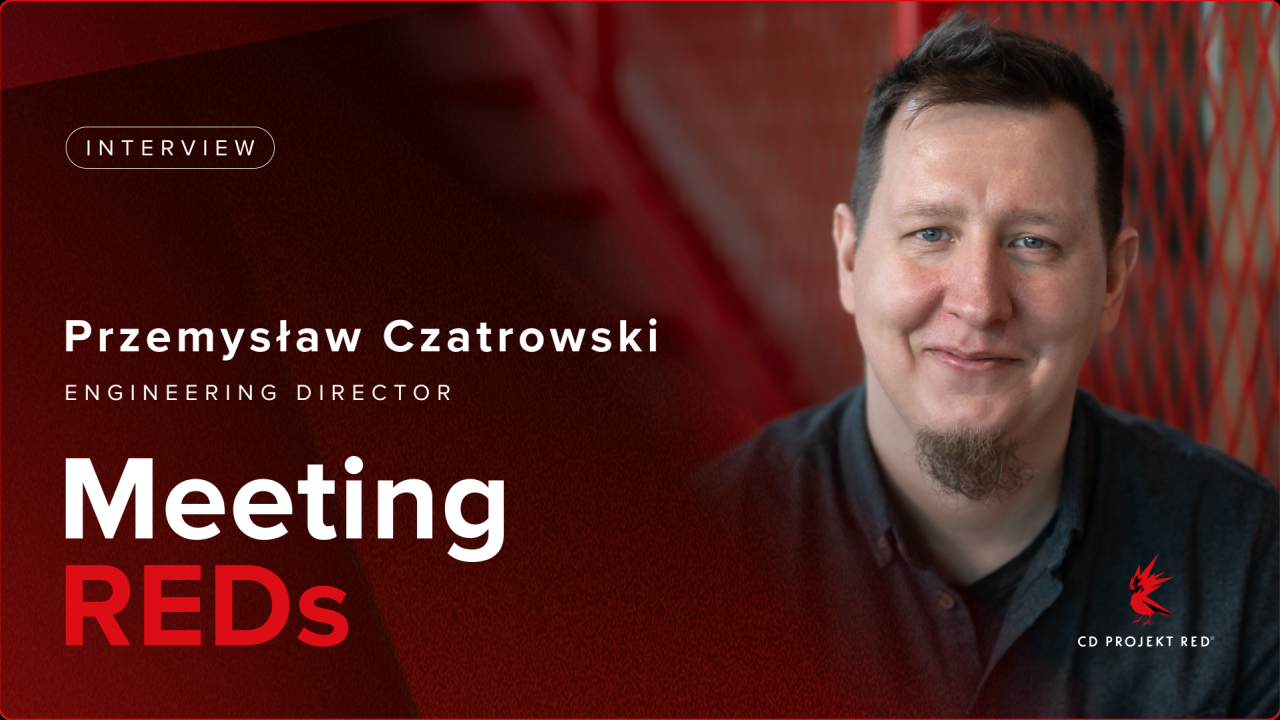
Our Engineering Director Przemysław Czatrowski celebrates 15 years at CD PROJEKT RED by sharing his story with us — one that took him all the way from The Witcher 2: Assassins of Kings to Cyberpunk 2077 and, now, The Witcher 4.
How important is a millisecond in video game engineering?
I think this is the main thing I learned doing this job: just how valuable, and how long, a millisecond actually is! Let me explain. Everything that you see in a game running at 60 frames per second — the reaction to your input, the animation, physics, lighting, shadows, etc — it all has just about 16 milliseconds to finish processing before the next frame needs to be ready and on screen. And it has to happen perfectly, over and over again, 60 times per second!
Can you comprehend having worked at CD PROJEKT RED for 15 years?
In no way was I thinking that far ahead as this ambitious youngster who joined the company back in 2011. It's a very long time, but in some ways it also feels like a snap of the fingers; time flies fast when you’re always learning new and interesting things, and learning was all I wanted to do because this was my first job in game dev. I had no prior experience, just an education in computer graphics.
How did your career grow over time?
My first tasks revolved around helping with converting The Witcher 2 to Xbox 360 — that’s two generations of consoles ago. Then I moved to developing The Witcher 3: Wild Hunt — and later experiencing the entire Cyberpunk 2077 production process, its release, and post-launch updates. And now I’m part of The Witcher 4 team. These were all very dynamic periods of very satisfying work — each one sprinkled with difficult moments, of course.
What has made you stick around for so long?
I found a place that constantly challenges me, and requires me to adapt to new situations and constantly develop; I feel I still have so much to do here. Every new project is more ambitious, bigger, more beautiful… The challenges keep coming and I welcome that. At the same time, we preserve the core of what this company is about: the meaningful stories, the emotions, the character development. And I get to work with incredibly engaged people who really know how to push the boundaries of what’s possible.
Do you have a favorite project, or moment, from your time here so far?
Well, I always loved The Witcher franchise; it was one of the reasons why I came to CD PROJEKT RED in the first place. That’s why The Witcher 3 was kind of the peak for me personally. It’s been over a decade but I still remember the release! It was a normal work day but I think everyone spent about seven hours just pressing F5 and refreshing Metacritic, checking as the reviews flowed in. I remember that thrill, that rush that everyone in the office had, to this day.
How has CD PROJEKT RED changed during your time here?
We made The Witcher 3 as a relatively small company, which undertook a huge project and delivered it, somewhat against all odds. Now we are much bigger, which means more people, more projects, and better processes. But I think at our core, we are still that same company that wants to create huge, ambitious games centered around narrative and emotions. And we want to do it to the highest standard. That does not change.
How was your transition to Director in 2024?
A few years ago, it was me trying to figure out, for example, how we can render a character's skin in Cyberpunk 2077 so that it looks more photorealistic, and is believable in all the lighting conditions (which in Cyberpunk 2077 were quite varied and diverse). Now it’s about figuring out how to set up a project, so the team has space to deliver the best possible quality for all of us. This was definitely a different kind of challenge. Transitioning to the management level means figuring out the dependencies between things: what order should features come in? What should we do first so that artists can start working on levels? What should we focus on now, so that in every subsequent sprint, we deliver value and allow other teams to keep moving? There’s a lot of conversations between teams and disciplines, and giving space is important. It’s about presenting problems to super smart people and giving them the space to find solutions, instead of just imposing work and taking away their creativity. Because everyone likes solving problems. Especially people who go into game dev. This is an industry where truly interesting problems are solved.
How important is that collaboration aspect?
You quickly learn that without working closely with other people, it's impossible to make a game. Maybe there used to be this idea, years ago, that programmers just sit alone in a room, but that isn’t the case anymore. You don’t want to spend a month creating an amazing tool in the game’s engine, only to find out that nobody needed it or only 10% is useful for artists or designers. Having a broad perspective is very important in this job.
What do you look for in new hires?
The ability to work with people is really high on the list. But above all, for me, you need to have that innate curiosity and an enthusiasm for solving problems, because your technical skills are something we can always develop. At CD PROJEKT RED we use Unreal Engine 5, so being familiar with that is one of the basic requirements. Thankfully, you can download the engine for free and learn it. And with all the resources available nowadays, it’s so much easier to find that knowledge than it was over a decade ago.
Do you still have that curiosity after 15 years?
Yes, because the challenges we face are changing with each project and with each technological advancement. There’s never a dull moment here.