How Visual Effects Breathe Life Into Games
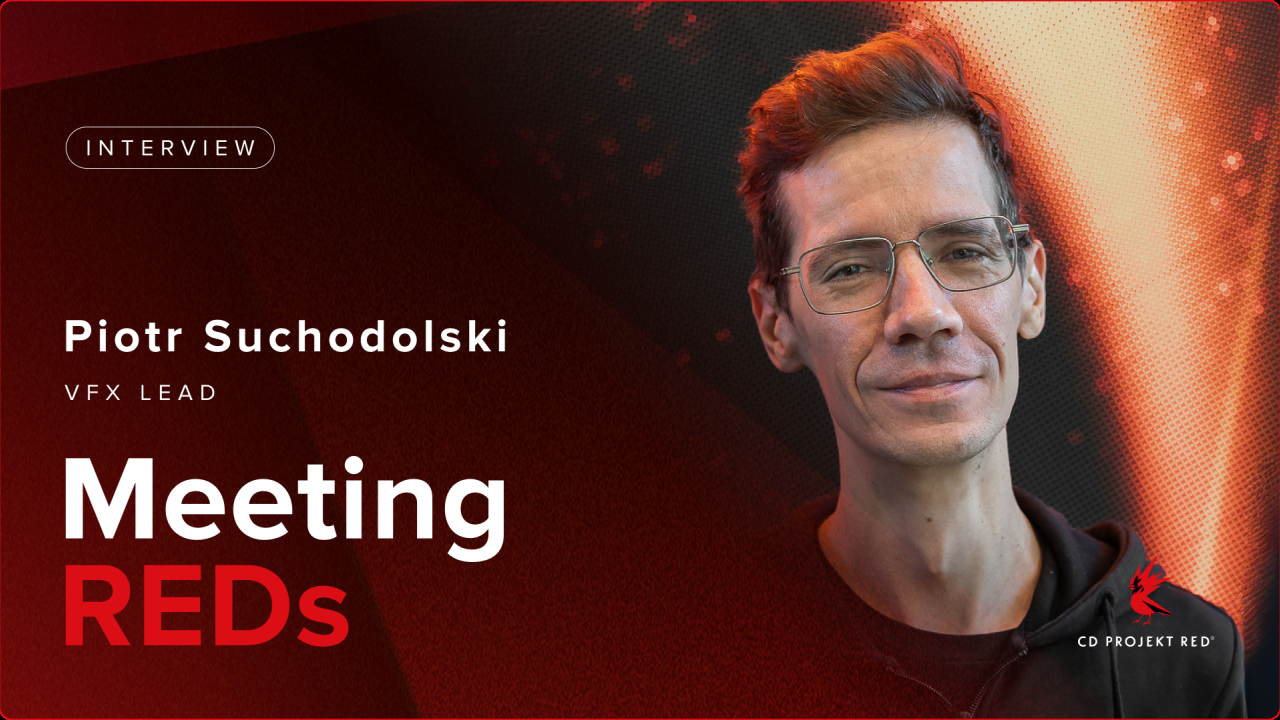
Self-taught visual effects artist Piotr Suchodolski is now our VFX Lead. But even after 10 years at CD PROJEKT RED and almost 20 in the industry overall, he’s as passionate as ever about visual effects and their importance in video games.
What was your introduction to visual effects?
There were a couple of signs very early in my life. As a 7-year-old I saw my first movie in the cinema, Jurassic Park. I still remember the impact it had on me. I was also a child who loved to draw — it was my favorite pastime — so when a bit later I got my hands on the graphics software 3D Studio Max 2.0, exploring, learning, and moving on to creating in 3D felt natural. I think that as soon as I discovered particle systems, I just knew that VFX was going to be my path in life. I was 14 at that time.
How did you get started in the industry?
I applied to Platige Image in 2008 with a portfolio compiled during my gap year. They liked it but I also had to complete a recruitment task: add finishing touches to a mouthwash commercial in which snow exploded into the camera, showcasing how great the feeling of freshness was. That shot took me two full weeks to perfect, but it worked. I got the job!
How was it going from self-taught to a full-blown cinematics company?
I was only the second person who worked on VFX at Platige, but I was seated in a room with must-know people if you’re into graphics in Poland. One of them was none other than now CD PROJEKT RED’s very own Global Art Director, Kuba Knapik — a person who has been so important in my journey. When I came into Platige as a junior he was already responsible for the most demanding projects, but still found time to mentor me. Kuba helped develop and shape my artistic sensitivity, something I’m immensely grateful for. I also had the opportunity to work on VFX for CD PROJEKT RED there: for The Witcher 2: Assassin’s of Kings’ cinematic with an exploding vial freezing an entire ship, and for The Witcher 3: Wild Hunt’s famous and bloody Killing Monsters trailer.
What’s your first memory of CD PROJEKT RED?
Well, it comes from before I was hired. I was in Canada at the time, and I mixed up the timezones for my job interview in Poland! On the day of the interview, I was just about to go to sleep when a recruiter from RED called me. I was petrified. I thought I’d blown my chance, but she just told me to relax, get my eight hours of sleep in, and we would talk in the morning. A few months later I came back to Poland and started work at CD PROJEKT RED.
Why is VFX so important in games?
Dust coming from under your character’s feet as they run along a sand dune is what breathes life into a game. Add the right kind of smoke on the streets and you immediately feel like you’re in New York. Fire smoldering in the oven makes a home feel lived in. You know there’s someone living there. Visual effects build the world and help position the player in it. They strengthen immersion and help sell the dream.
How do VFX artists determine how something should look?
That depends on the effect! On one of my projects at Platige, we created something where the planet’s surface explodes after being hit by a comet. This is really like an atomic explosion where enormous energy is released on impact, so you start by studying as many giant explosions as you can and applying that to your work. But some effects don’t occur in nature at all; that’s when you need to be creative.
How do you create something that doesn’t exist in real life?
Most importantly, you need to remember that visual effects in a game or movie do not exist in isolation. They need to tell a story which is consistent with other elements of your production, with the bigger picture. This is particularly true at CD PROJEKT RED, given our strong emphasis on collaboration when crafting memorable stories in narrative-driven games. However, visually you should look for a way to ground an effect, to associate it with something that we all know and have seen in our lives. It may be different context, but if it looks and feels plausible, it can work.
How does VFX play its part in telling a story?
Visual effects amplify the players’ emotional response, which for me is the most important guiding principle. We should always ask ourselves how an effect makes people feel. And I want our effects to be unique! I feel we at CD PROJEKT RED have a duty to try and advance the way VFX is made overall — not just for us, but for the entire industry.
Can CD PROJEKT RED achieve that?
Over the last two decades there’s been massive technological advancements in many areas of video game development but somewhat less so when it comes to VFX. Take rendering, for example: 15 years ago, no one imagined that ray tracing and path tracing in real time would even be possible! We need innovations like this in VFX too, and I want to help usher it in. New technology really makes it that much easier to be innovative and creative.
What makes a good VFX artist?
I think a good VFX artist is a combination of artist, technician, and animator. Great composition can't exist without spot on timing, plus technical skills help out a lot with extending the possibilities of our tools and help with keeping the effect performant. And you should be mindful of other teams. Communicate with them well to understand where they are coming from, so we can keep the consistency and tell the same story. Because again: effects do not exist in isolation.
How do you determine what’s good when evaluating others’ work?
There’s so many different artistic aspects to consider, like the relationship between different sizes of elements, the contrast of color values, the energy and mass conveyed by the timing… But in the end it all goes back to that emotional response. What feeling does it give you? I really trust my intuition on this, and I also believe you can sacrifice some elements of an effect to keep it consistent with what’s going on around it, with the story and gameplay. Because in the end, it’s the full picture that matters, not an individual part.
Do you still find opportunities to grow at RED, even with so much experience?
Definitely. We are developing multiple ambitious projects at the same time, with so many talented developers constantly pushing the boundaries of what’s possible in video games. On top of that, we have direct lines to external experts in multiple fields — so there’s a lot of talented tech people to learn from! There’s really no better place I could imagine myself working. It’s all here: the projects, the people, and the technology.