Building Games and Teams in Boston
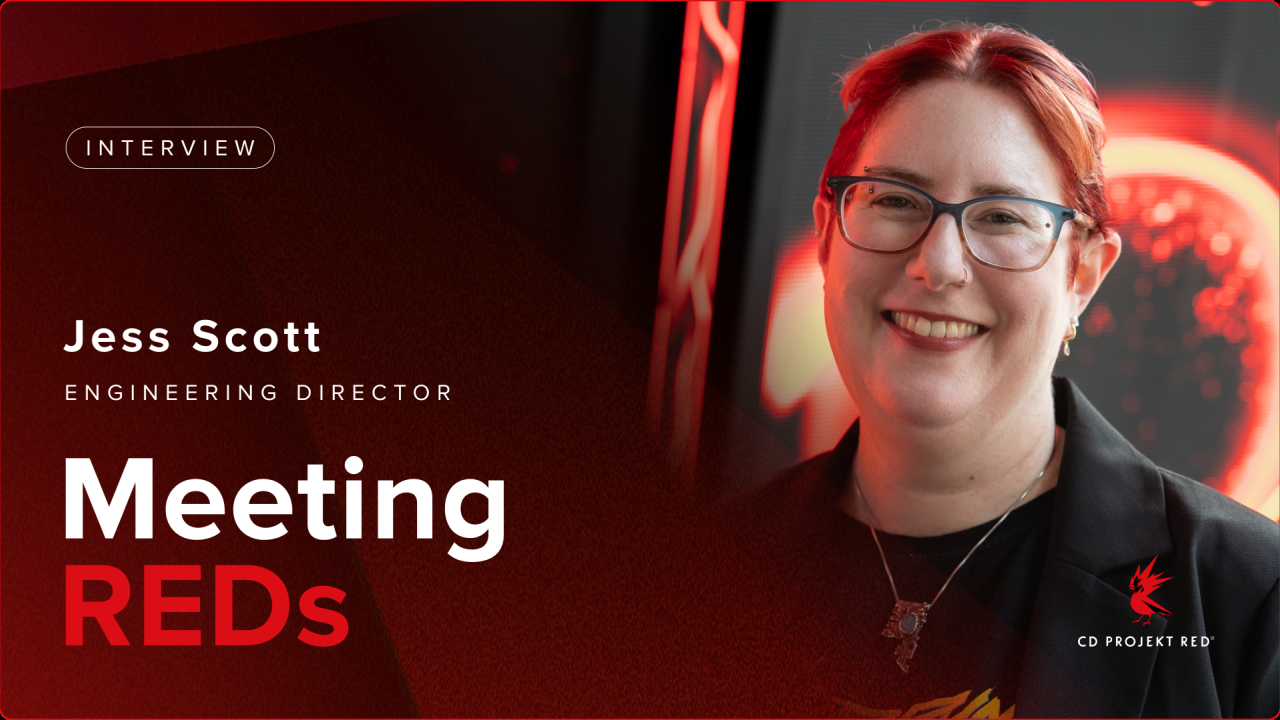
Jess Scott is our Engineering Director on Cyberpunk 2 and currently helping grow the CD PROJEKT RED team in Boston! Learn about her management philosophy, collaboration at RED, and what skills are necessary to be a AAA video game engineer.
What do you do at CD PROJEKT RED?
I’m the Engineering Director in charge of gameplay on Cyberpunk 2. On this project we have three Engineering Directors and split up the work between us. The role is full-time direction and management, so I may at some point do a little bit of code, but it’s quite unlikely it will ever be on important features. Right now, my focus is very much on building the team. Since we are in pre-production, we need to hire a lot of Engineers, and we need to structure the teams for success. So I’m currently doing a lot of hiring and interviews, and also spending a lot of time learning about what the project really needs on the gameplay front. This involves going to meetings to understand what we’re currently doing and what we need to be doing for the game and overall player experience, and then figuring out how we can support that on the engineering level.
Does your role involve a lot of collaboration?
Absolutely. There is a lot of cross collaboration, both at the director level and with the teams. One reason we split the Engineering Director roles up is just to make it easier for people to find one of us, but there’s a lot of overlap in what each Engineering Director covers. For example, Pierre Fortin, who is the engine Engineering Director, is going to be working with folks in the Environment team to figure out worldbuilding, loading, and streaming — but this is also very related to crowd work from the Gameplay team: spawning crowds and making sure they exist in the world. There are actually a lot of connections between our work, and we collaborate all the time across the Engineering teams. I also really love the fact that our gameplay team works super closely with artists and designers and animators; great collaboration among disciplines is one of the things that leads to awesome gameplay.
Is it important for you to stay open and available?
I definitely don’t want people to feel uncomfortable coming to me with questions, no matter who they are or what they do. I believe that great ideas come from everywhere, and the people who are on the team and working on these projects are the ones directly experiencing what is going on — getting their feedback to the director’s level is really important so we can make good decisions. I enjoy spending a lot of time just talking to programmers and seeing what they’re up to, what their challenges are, how they’re feeling about work, and so on. That information always really helps me with making calls on technical direction.
What do you enjoy about being an Engineering Director?
One of the things that really drives me is helping teams be happy and healthy. I love working to create and maintain a great culture, so that people feel supported and enjoy life in the game development industry. I truly believe that a happy and healthy team makes the best games. When I first had the opportunity to work as a lead, it turned out that, while I very much love coding, I feel like the problems that I can solve as a manager are different, and sometimes more important for the team. I like being able to keep things on track and make sure that everybody has the right work to do.
What’s your experience in the games industry?
Most of my time in the games industry was actually spent at Harmonix Music Systems, which is local to Boston; we made all the Rock Band and Dance Central games. I worked at Harmonix for about eight years, then I spent a year at Amazon Games, and then several years working for Amazon not in games. But I really, really love working on games! It is what I want to do with my life. So I was excited to get back into games at Insomniac, where I worked for six and a half years. There I directed the gameplay department across all projects, and in August 2025 I joined CD PROJEKT RED.
Do you have advice for those looking to grow as engineers?
I would say for engineering positions, an important starting point is to have a solid technical foundation — so you need to be able to code, you need to be able to do vector math, you need to be able to understand low-level C++. Then, it’s always nice to see excitement about games and passion in somebody’s resume, or in conversations with them. That’s really important. So obviously, when looking for programmers, we want people who have strong technical skills, great C++, good math… But we also want to see people who are great communicators, who work really well with designers, who can collaborate with people in other disciplines. We’re not looking for programmers who sit in a box and code. We’re looking for game developer programmers.
Does creativity play a part in engineering?
I think that creativity is something that everybody in this industry displays! Certainly, you can be creative with code just as much as you can be creative with design. Something else that we look for falls under the term ownership. We look for someone who not only owns a system, but who is also really active in raising awareness of the system, and interacting a lot with the people who use it. It’s always great to see programmers who are focused on customers and players. Imagine a programmer working on a set of designer tools: we want to see somebody who’s going to go to the designer and say, “Hey, try this out”, who’s going to use it themselves to make things in the game, and who’s going to be really focused on making a great experience for the people who are going to use their tools. Always keeping the player, designer, and artist in mind is really important, and we do look for it when we’re hiring.
What’s it like working at CD PROJEKT RED’s Boston Hub?
I am really loving the energy in the Boston Hub right now. We have a lot of people who are core CD PROJEKT RED folks who have been around for many years, and then we have lots of people coming in from across the industry with new ideas and different ways of doing things. I’m really happy with the melting pot kind of energy, and the way that we are all looking at what we do and trying to figure out how we make it better, how we integrate the best of the new with the best of the old. I also love the energy of Boston overall; with all of the colleges and students in the area there’s always something going on. I’m also excited we can support remote work though — we have Engineers everywhere from Poland to Vancouver, and being able to hire remotely really lets us access an amazing amount of talent.