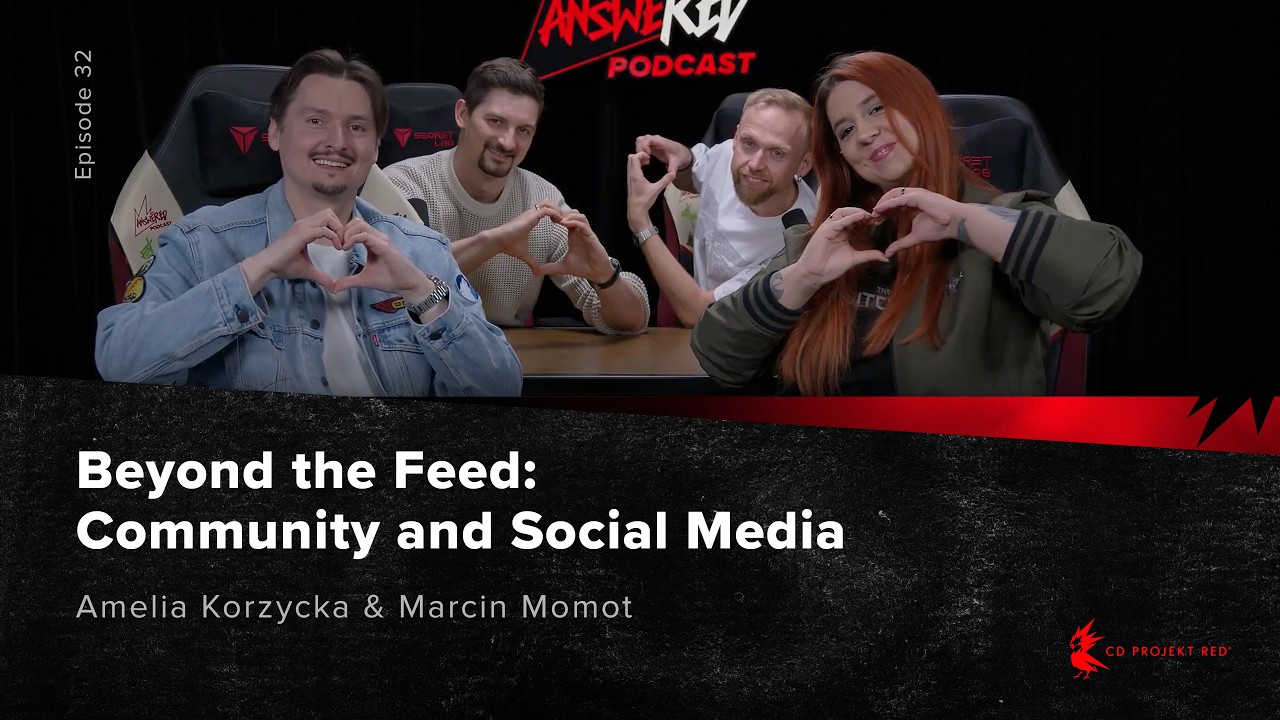
AnsweRED Podcast Episode 32 — Beyond the Feed: Community and Social Media [Transcript Included]
![AnsweRED Podcast Episode 32 — Beyond the Feed: Community and Social Media [Transcript Included]](https://common.cdn.cdpr.app/cdpr/news/main/94ac2489f40cd24d3f49f3c55710bb39_q90_1280x720.png)
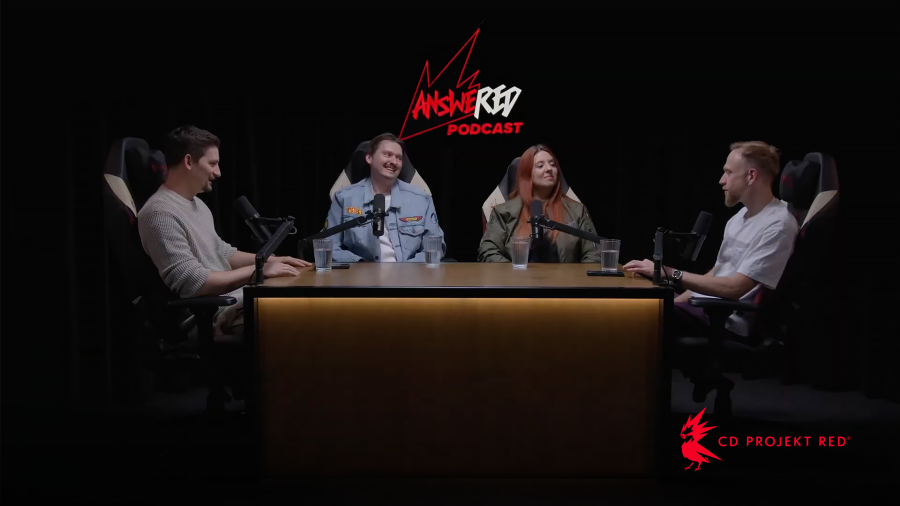
In Episode 32 of AnsweRED Podcast, hosts Paweł Burza, Tabletop Games Manager, and Paweł Mielniczuk, Art Director for Project Hadar, are joined by Expert Community and Social Media Manager Amelia Korzycka and Global Community and Social Media Director Marcin Momot. Together, they take a closer look at community management at CD PROJEKT RED — from connecting players and developers and turning feedback into actionable insights to communicating across more than 100 channels in 13 languages. They also share what happens behind the scenes during launches and unexpected events, and reflect on what sits at the heart of it all: passion and people.
Want to hear the full conversation? Watch or listen to Episode 32 now, or keep reading for the complete transcript below. We’ve lightly edited the conversation for clarity and organized it into sections to make it easier to follow.
Intro and guest introduction
Paweł B: Hello and welcome to the AnsweRED Podcast. My name is Paweł Burza and I am joined by Paweł Mielniczuk, the Art Director for project Hadar.
Paweł M: Hey everyone. Today we will dive into Community Management here at CD PROJEKT RED with Amelia Korzycka, Expert Community and Social Media Manager, and Marcin Momot, Global Community and Social Media Director.
Paweł B: It's going to be an amazing episode. I can't wait to meet our guests, so let's just meet them. All right. Amelia, Marcin, welcome to the podcast, officially. My favorite topic today, community. A topic I feel very familiar with. But before we start, could you both introduce yourselves, especially to the people who are listening to us so they can associate your name with the sound of your voice?
Amelia: Absolutely. Well, hello, I'm Amelia Korzycka, I'm Expert… — Almost said "senior" — Expert Community and Social Media Manager at CD PROJEKT RED, and I've been here 11 years already.
Paweł B: Wow. And counting.
Marcin: Nice. My name is Marcin Momot, and I'm the Global Community and Social Media Director here at CD PROJEKT RED, and I've been with the company for 15 years now.
Paweł B: Wow.
Paweł M: Nice. A lot of experience.
Paweł B: Together, 26 years in two seats. Incredible.
Marcin: I never thought about it that way, but whenever you start to combine people's tenures at the company it always then adds up to, like, insane numbers. So it's nice Paweł that you brought it up, actually.
Paweł M: A lot of experience.
As always, we kick things off with some introductions — meet Amelia and Marcin!
Building bridges between developers and players in CD PROJEKT RED
Paweł M: All right, so, community. Please, let's start from maybe unpacking what actually community means for us in CD PROJEKT RED.
Marcin: Well, it's a good question. And to be honest, to me, the term is-- The definition is broad, but it's broad by design. So let's say if you played our game, if you played Cyberpunk or if you played any of The Witcher games, or if you play one of our board games or read a comic book or watch Edgerunners, to me, you're part of our community because you, with all the people around the world, share the same passion, share the love for the stuff that we do here at the studio. And obviously, there are people who are, let's say, active on our channels and they choose to engage with us. You know, they follow us on Instagram, on Facebook, on Twitter or X. Some people engage in community driven initiatives such as Reddit. You know, some people also sign up for our Discord server, right? And these people actively engage with us. However, to me, it doesn't matter if you're actively engaging with us or if you're just, you know, playing, watching whatever we're doing and you're enjoying it. To me, you're part of the community.
Paweł B: Because sometimes there is this overall appearance from outside that community management kind of is boiled down to just posting stuff on social media. But there's this whole aspect of building a, let's say, almost a global society around a certain game in this case, or a certain anime or a certain product, for example. So would you say that because as you both introduced yourself there is the social media aspect and there's the community aspect. And I feel like there is a justification why these two things are there mentioned together. So is it just posting or is there more? I know the answer, but I want to hear it from you.
Amelia: I think it would be easier to say what we don't do than what we do, because this is really big. Like when the game is in production, we also play our games, we test our games, we provide our perspective like, "oh, players might not like this" or, "oh, this is going to be a hit, maybe we should focus on this aspect more." We are part of our partnerships with our Biz Dev. Obviously social media is still a big part of it. We are obviously the ones pushing the buttons. Go live on whether it's a patch update, partnership, a meme, or a fanart, right? We look for those things. We do research, like what other companies are doing. And is it something maybe we can look at and see how we can maybe do it our own way because we never did it before. So our day-to-day is very long in terms of like those eight hours. Social media is part of it. But talking to people, responding to emails, responding to comments, looking for new initiatives that, oh, our players like to do this, maybe we can do this for them. And obviously partnerships, content creators, all that. So, again...
Marcin: Yes. Community ambassadors, projects, I mean, projects are a big part of our work because one of our values is being ambitious, right? And every time with every release, we're trying to beat what we did for the previous title, and we're trying to do better and more engaging things for our community. You know, if we're thinking about cosplay contests or any sort of contest or any sort of, you know, activation that we can do for any other parts of the fandom, like, this is something that sometimes takes weeks, months, or even years in extreme cases to deliver. So there's a lot of also behind-the-scenes stuff going on that later on then comes out and then people can enjoy it.
Paweł B: Perfect. I also feel like, correct me if I'm wrong, that the Community Team overall kind of bridges the gap that is in between developers and the community. So the voice of the community can be heard by the developers through the means of the Community Team. And like you kind of mentioned, the things that you see early in development that can potentially be good or bad, let's say, and how, how they can be received by the community, and also what the community might kind of like to see once the game is launched or when an update is pretty much coming out. So how in your own view is this part of working with developers, working with the community, bridging the gap and kind of trying to hear both sides of the, of the world, let's say.
Amelia: It is actually important that this bridge goes both ways. So it's not just from dev to community, but also from the community to devs. So whether we release a patch, whether we have, I don't know, a hands-on session, we talk to people and try to hear them, what they like, what they dislike, what's missing. And then we do reports, you know, it's part of our job.
Paweł B: Sentiment reports.
Amelia: Yes. Sentiment reports, numbers, like, this feature got picked up, or maybe our social media trend that we used to showcase a feature from the game was actually very likable. And people would love to see that more. For example, we did-- That was ages ago, for Cyberpunk, when we added more hairstyles and we added a GIF with different hairstyles, like what hairstyle do you wear today? And we got a massive response to that. People asking, "Can we have more?" "Can we have more hairstyles?" We're like, there's already so much. Can we have more? So using those like little bits on our own, and then we send it to devs and they're like, okay, so maybe we can focus on this aspect in the next patch, or maybe this is more important for people than we thought about. So we gather all those things, even simple messages from community, like our game is meaningful to many people. And they say like, "Oh, I love your game." "I met my husband, I met my wife through your game." And we also send those to the devs because... Days sometimes are hard. And this is a message to uplift them, that what they do, what you guys do is actually very meaningful, not just for you as a developer, but also for people who play those games. And it actually means a lot and as Marcin said, they might be just lurking on our socials, but they send this one message and that message will stay with you for much longer than someone who is sending thousands of messages each day.
Marcin: Yeah. And if I may, speaking of sending us stuff, we also have a very soft spot in our hearts for physical stuff that is unfortunately more rare than ever with each day. But I'm sure all of you know, we have a special place, a room in our office where we store all those physical letters, the fan-made creations, you know, sculptures and all the other cool things that people send us. And some of them are even displayed around the office. Right? We have Eredin's head sculpted from stone, We have some wood carvings, We have a lot of different things that are displayed around the office because they just mean so much to us.
Paweł M: It's always a special moment, too, when you're sending us the messages from the fans, which are heartbreaking sometimes. Sometimes there are just amazing stories that people share about what happened in their life when they're playing our games. It's always, you forward it to us to read it as developers. It just, you know, makes us feel that we are making meaningful stuff, something that is very special for those people. And a lot of companies are outsourcing the community management to external companies. And what is the biggest true value of having the Community Team inside the company?
Marcin: So in my opinion, there are two layers to this. The first layer is definitely part of being the culture, being a regular employee in the studio and living, breathing by the same values, by the same standards. And, you know, knowing the developers, working hand in hand on stuff and just having good communication on a day-to-day basis. And then the second layer is, which is very important in today's day and time is the reaction time, honestly, because quite often when you're working with an external partner, yes, they can be, you know, the best there can be, but there will always be that delay, right? Like when we're sitting side by side and I can just walk to you and we can have a conversation about this issue that we're having right now and what we can do about it, it's always much faster, much more rapid than just, you know, sending an email or sending a message, waiting for someone to get back to you. And so those two combined, there's obviously a lot of different factors that are probably smaller, but to me, these two play the biggest part when it comes to advocating for having an in-house Community Team that is responsible for communicating with your players around the world.
Amelia: And I think it's also the personal level. I feel like that's why our Discord is so alive, because we are there. Obviously, we're the faces of the company, but like people feel more engaged and I think more happy when they see an actual person from the studio responding to their even the weirdest comments, right? Or like just saying hello. I think this means much more to them and you wouldn't be able to do it via agency or external partner.
Paweł B: I think it also makes it more genuine. I feel like if it's coming straight from someone who is an employee of a studio, and you're playing that game or you're admiring what they do is like having someone come out from the studio, actually talk to you, is like, it feels a little bit like being star struck. And I'm gonna use this story that I always use whenever Marcin is in a room and I'm in a room and we're recording something. It's like, I joined the Community Team ten years ago as an assistant in the team. I was working with you. I remember I joined at the time when I was playing The Witcher 3, and before I joined, I had a problem. I had a bug. It was before patch 1.08 for The Witcher 3: Wild Hunt.
Paweł M: Great memory.
Paweł B: It's a good memory.
Amelia: So no wolf chest.
Paweł B: It's a good story. So I was in the part of the game where you're in Kaer Morhen and you're supposed to talk to Lambert, but there was this bug that Lambert would collapse, go underground, and you couldn't interact with him. And I wrote that on the forums. I'm like, I have a problem with this bug. Is there any known, like ETA? I wasn't expecting anything. I wasn't expecting an answer. Marcin actually answered that, said, "It's coming in the update that's coming at the end of this month." And I was like, wow. I contacted out of the blue on the forum and I got a response from CDPR, whose games I have been playing since Witcher 1. It's like, mind-blowing. And I know before that, whenever I would send any type of bug reports or whatever, I would go to like an automated thing and talk to "Unknown name", let's say, and then kind of feel like my problem wasn't even handled and I didn't get a proper interaction Here, I was surprised that there's so much thought put into this and that the people who are coming in from the community are-- You feel seen. That's what I'm trying to say here through like all this whole story time. So this was very cool. And this is something that really sold me, initially, on what CDPR does for players. And from that point on, I was sold. So yeah.
Amelia: I mean, it's also like the story of Ryan from our German team, right? He was a fan of Gwent and I remember meeting him at one of the Gamescoms. We had King who was also part of community.
Paweł B: Our Korean community.
Amelia: And they're like, still here and they're actually employed and doing the same job.
Paweł B: On the other side now. But they were all connected by that one good experience that we had and kind of defined us and how community management should be done. And yeah, it's incredible that that quality is still there. We're keeping that.
Marcin: Yes, but it also started with you being part of the community. So kind of tied into what I said in the beginning, like you played the game, you liked it, you decided to engage with us and now you're here. We're all together. However, as we grow as a company, it is more and more difficult because we get a lot of messages. We get a lot of contacts from all over the world in a way that, you know, our community is growing, which is great and we are growing as a team. However, there are, let's say some challenges related to that because again, it's much harder to get back to every message.
Amelia and Marcin explain what community means for CD PROJEKT RED, what community management involves, and the benefits of having an in-house Community team. They also discuss how the team helps ensure that players’ voices reach our developers.
Community management across different projects
Paweł M: And now it will be even more hard because we became a multi-project studio. So there are multiple projects running at the same time, patches being released all the time. Some additional content, etc. So there's more and more interaction happening. So what is the moment when the Community Team is being engaged into the new projects?
Amelia: I think like, even, let's say, Phantom Liberty, right? It was months before the release and even months before we kicked off internal campaign planning. We could play the game so we know what's there. And it's not about just us planning the campaign, but actually knowing the game because like, imagine if someone is reaching out to you asking a question about, I don't know, "Is this person this and that?" Or like, "How can I adjust my talents?" or something, and you don't know, then there is a problem. You, as a community manager who is talking to players, you should know those things. So we often like to sit down and play the game, even if the game is like all gray blocks. But the plot is there. Like quest lines are implemented, stories implemented. So we know things. It's not just for the campaign, but actually for us.
Paweł M: So you know the game from the ground-up. From the beginning of the development. You see how it changed, how it evolved. What kinds of changes were implemented during production. So you can better also, for example, respond and you have the whole context answering the questions of the community or forwarding their feedback to us.
Amelia: Yes, and we can still report bugs if there is something that's not working In our minds, maybe this shouldn't be like that. So we can also be useful for developers.
Marcin: I think that's one of the greatest things about our company is that basically, you know, obviously, yes, we have procedures, we have workflows, we have pipelines for everything. However, if there's something that's really of importance to the community, you know, we can just reach out to one of the designers and be like, "Hey, we're really having a problem with this." "I would like to escalate this." "I would like to make sure that this gets brought up." And you can actually succeed. So everyone is just approaching, you know, the issues that are at hand with an open mind and with the proper, proper attention. So that's why I love working here. And I think everyone is just, you know, bonded by this one goal to like really deliver a meaningful experience for the players. And if there's stuff that needs to be fixed, we work together on fixing it. You know?
Paweł B: I think this has always been the core value of CDPR, we have it as, "always remember about gamers". But it's always been that way. If it comes down to how we do our products, how we kind of interact with the community, like through every aspect, when it comes to us as a company, we always have gamers in the forefront so we're kind of always thinking about them. So that's, I feel like, super important. And like you also mentioned, I remember when I worked on Gwent, we always had to know how every card interacted and worked. So you really need to be a jack of all trades. You need to know everything and it must be more difficult now, like Paweł mentioned, we're doing multiple projects. But apart from that, we're also doing a lot of things that expand the franchise. We're doing the animes, we're doing board games, we're doing a TCG, we're doing multiple other things. We're also doing a lot of collaborations, having our characters go into different games and stuff like that. So it's really just more and more and more interactions and more communities from different places coming into our community and kind of seeing the people that are already there. So it's just like, the scale seems like it's ever growing. Must be incredible, too.
Marcin: Scale is one of the things that I think changed a lot over the recent years, and both in terms of the fandom and how many people we have in our community. When I joined, we only had people who were into The Witcher 1 and Witcher 2, because it was before The Witcher 2. So people were anticipating the second part of adventures of Geralt. And then over the years, you know, we started having people who are really into Cyberpunk and they might not necessarily care about The Witcher, right? But we still, you know, we also have people who are into both franchises, right? We also have people who are only into anime and they just watch Edgerunners, right? So it's awesome that we have so many people who have all these interests. And some of them, they share them, some of them, they're just really into their thing. And that's beautiful as well because they came here, they chose to, you know, support us. They chose to be part of this community. And I think this is great.
Paweł B: Yeah. I also like that you have a platform to talk with the community. If it's, like you mentioned, if it's forums, if it's Reddit, if it's any type of social media, like Twitter or X, Facebook, and all that, there's just more and more also communities on different social platforms that you get to interact with. But one thing I kind of want to touch upon, this wasn't in the original script. What I think is also very cool is that you set up a tone of voice very early on when a project is starting, where you kind of define how the social media will actually talk with the community. So I want to kind of touch a little bit on that, because we saw that the tone of voice, for example, for The Witcher was a little bit different than for Cyberpunk because of the different setting and how different the two games were. So can you talk a little bit about this process and kind of like, how do you define how The Witcher speaks versus how CDPR speaks versus how, you know, Cyberpunk speaks?
Marcin: It's a team effort. That this is something I can start with and also to tap into the question of how and when we are involved in the game dev process. So basically when we learn more about-- Obviously, with The Witcher, it was easier because The Witcher was already there. With Cyberpunk, it was a bit more challenging because it was a new franchise for us so we had to learn more about, you know, the source material. We had to learn more about the game and then figure out, okay, how can we match what is happening in that world. How can we talk like, you know, a bit like the characters? How can we be relevant to the audience? So when they, you know, finish the game, they go and check out, you know, what's happening on our socials, you know, new patch coming or whatnot, that they don't immediately get like taken out of the immersion. But this is sort of like an extension, right? Obviously, we don't really want to go all, you know, way overboard and be like, cringey or whatever. Right? I mean, obviously, as with everything, sometimes it happens unfortunately. But thanks to everyone's feedback, we do better and we try to implement it.
Paweł B: Course-correct.
Marcin: Yes. So it's something that we design at the beginning before the campaign kicks off and then we start working on it. Obviously the tone a bit, you know, adjusts and changes as the campaign progresses. And thanks to the feedback from players and also internally. But I think it's an iterative process. Honestly, like the foundation is there, but we don't hesitate to also, as you said, correct the course and see if there are any adjustments that need to be made because we really, again, we don't want to take it too far. And we first and foremost want to be engaging for the community. We want to be insightful for them. We are, as you said, like we're the link between the studio and the players. So whenever someone is going to check out the patch notes, yes, they should be lore-friendly, sometimes in character, but first and foremost, they should be informative. They should be, you know, a good resource for them to see, "Okay, well, that bug I really wanted to be gone from the game is now fixed." "Cool. I can identify that immediately." So yeah, there's really a lot of work that goes into prep work way before the campaign even starts. And then once we're actually in the campaign, there's a lot of work that goes behind the scenes again that we just work on stuff.
Every project has its own community, with unique interests, expectations, and ways of engaging. Amelia and Marcin discuss how the Community team adapts its approach across CD PROJEKT RED’s games and other projects.
Dialogue with community members
Paweł M: When the game is finally released, you said that you were getting feedback. So can you share some examples of what kind of feedback, taken from the community was actually implemented in the game?
Amelia: So I think, one of the biggest changes that we actually did implement to Cyberpunk was our photo mode. We've seen the potential of our tool and we've seen the potential of our devs, like what we can do more to make it better and bigger. And obviously the community who was making those screenshots and they still are making those screenshots. Sometimes I actually have to look very closely. Is this a screenshot? Is this maybe like a proper picture? Because we have talented people within the community. So for, I think one of the last patches, I think 2 or 3 patches ago, we did contact several content creators in the virtual photography field and ask them like, what can we do to make it even better? What's missing? And they provided us with feedback. Their feedback. We did share it with the team. And we actually got all the changes that they wanted implemented. Sometimes in the first patch, sometimes we had a few extra things in the latter patch, but it's there. Radio station is, I think the other example that I know people wanted to listen to radio while walking on the streets. So not just in the car. It's there. So that for sure. And The Witcher 4... Not The Witcher 4, The Witcher 3...
Marcin: We'll get there eventually.
Paweł B: Spoilers!
Amelia: But like, for Witcher 3. Again, the next-gen update, like the mods, we do hear our community when it comes to mods on consoles. And we do hope it's finally coming at some point. So we do listen, sometimes it takes more time, sometimes it's faster, but it's there. And I think like, yeah, photo mode for me is like the biggest one.
Marcin: Yeah. Huge shout out to the virtual photographer community because these guys are amazing and so talented. And I think regarding Cyberpunk in general, the whole post-launch support has been very much, you know, influenced by the feedback from the community. You know, the metro system, right? Which we finally added, the whole UI overhaul. There's a bunch of changes that came with Phantom Liberty.
Paweł M: Mini-map changes, I remember.
Marcin: Exactly. Mini map, perks redesign, talent redesign, and also the police system. Right? The whole AI. So there's a lot of things that were, you know, thanks to the feedback from the community. And I think that's beautiful.
Paweł M: Just amazing because there's, you know, we are a limited amount of people that are just working on a game for years, five, six years sometimes. And we sometimes just get used to something, some things that are problematic, but we don't consider them as being problematic. And then we finally release it to the players. And there's all this feedback, it's just like, oh, it was obvious, but we didn't even think about fixing something. It's amazing to get this amount of people playing the game, testing it, giving their opinion. After all, we are making this game for them, right? But the photo mode was also-- I remember that, because like, yeah, we are artists, we made the game. We thought we mastered it, but then we are getting stuff from the community, which was just amazingly beautiful for us also. Right? And people just finding this, you know, like street photography, proper beautiful shots, photographing characters. I remember, I think it was this receptionist from Clouds. It was just an appearance. I made it and I just, you know, okay, I'm just bashing appearance now. I was not putting that much attention into it. And then, you know, I saw this character in photo mode, like absolutely beautiful in this context. And people were crazy about it.
Marcin: She's one of the community favorites actually.
Paweł M: Yeah. So it's amazing actually.
Amelia: Same with Aurora. Actually, there is, like, so many beautiful portraits of Aurora. Yeah. Like we definitely have a talented community when it comes to virtual photography. And it's just like, mind-blowing to wake up, even today, after the PS5 Pro update. I was scrolling through Twitter earlier this morning and I saw one of our core virtual photographers posting pictures after the patch and I was like, "Dude, that's not possible." This is a game, right?
Marcin: But really, let's give a shout-out to all the other pillars of the fandom because, you know, like we have illustrators, we have people who cosplay and you as a person who worked on characters...
Paweł M: Close to my heart.
Marcin: Exactly. To create characters that resonate so deeply with people to, you know, create the costumes and bring them to life is just amazing.
Paweł B: Well, we can also kind of bounce it back to you because you guys do the cosplay guides also, which kind of let people who are maybe getting into cosplay, don't know how to like, design a certain character. They have all the close-ups, they have all the renders, the models. It's all like super high-resolution. So there's like, you can see all the seams and all the connecting tissue and everything and you know how to like bring that back. So what you've always been very good at is like, whenever we launch a game, there are guides always coming out on time and people can like, oh, next event you go to, you have people cosplaying this and this and that character.
Marcin: I remember for Cyberpunk, I think it's been pretty smooth. But like, if you remember how it was for The Witcher 3 where we were, you know, releasing some of them even before the game came out and some of the stuff was still in the works, let's say. And we were, you know, trying to put those cosplay guides together. It was fun memories. Yeah.
Paweł M: Yeah. But we always try to design the costumes, the characters, in such a way that they can be cosplays, right? So it's easy to recreate, so we don't use rubber armors, etc. and then it's just fantastic to see those things being executed in real life and real photographs with real people. That's something we enjoy a lot.
Paweł B: It's been always cool to talk to cosplayers because they were also saying for some, for like the characters that you guys do, they're very cosplayable. Like, you can actually sew this whole costume together and you can actually wear this. And it works. Of course it was different maybe for the Wild Hunt, I know, but we had like super experienced people in the community that made these armors and stuff like that and wore them. So it was also incredible to see these things just come to life. And whenever you go to an event, you have awesome cosplayers. And let's say you're doing any type of like hands-on or just a community gathering and people are coming dressed up. That's so cool. So like, you see the passion.
Marcin: This is like, to me, because one thing is to see them online. But when you actually meet a cosplayer in person at an event, it just blows my mind when I see the level of detail when I see the craftsmanship and the passion, when I talk to these guys, it's just so amazing. And it just, you know, it totally makes my day. Every time I meet someone from the community who puts so much work and effort and time into bringing these characters to life. It's amazing.
Amelia: And it's not always about just the costume itself, but like we had cosplayers of Lizzy Wizzy and I'm like, when I saw the first cosplayer in a Lizzy Wizzy outfit, I was mind-blown because she was actually wearing steel on herself. And I was like, that has to be so heavy and so uncomfortable. But she was smiling all the time. She was at the event all day wearing this exact costume. So there's also a passion not just for costume, but general characters even before playing the game, because that was even before the release. So it's not just only about the regular clothes and regular cosplay, but like also those big-- I think on Pyrkon last year we had Leshen doing a cosplay. This is also like--
Paweł B: Which is like huge. It just shows the dedication of the community that is around the game. Circling back to sentiment and kind of tracking what the community is saying. Do you have a certain tool or a certain way that you gather sentiment and you kind of sift through all the things and define like, okay, this is the highest priority. Kind of like if you, if you take an example out of game development, you have your P0s, you have your P1s, P2s, and down the road. How would you kind of track it when it comes to the sentiment that is coming through the community? Because as we know, social media, there's a lot of opinions. There's a lot of sentiment there. Positive, negative, neutral. How do you track all this and how do you distill what's the most important thing here?
Marcin: It's a tricky part because as you said, there's a lot of voices out there. And obviously as people we're responsible for listening to what people are saying. We obviously constantly try to monitor it. We have tools and we have the cadence that also is relevant to the, let's say the time period we are in, because obviously we have recurring reports that we supply the teams with. But also, let's say we release a patch. So shortly after the patch has been released, we try to see what are the top issues, what people are talking about on social media and what are people talking about on our community channels and together with the player experience team, who are also responsible for taking care of the requests of players reporting the bugs. We are distilling what is the, let's say the highest priority. And then we are submitting that stuff to the dev team. So that's how it is in a nutshell. And obviously again, when we are, let's say, around the launch of the game or like, right after the launch of the game, this is when the reports are a lot more frequent. We're like closely monitoring what is going on with the game. What are people talking about? Right? But when we are in between campaigns, let's say we obviously-- yes, we do monitor it, but then we focus on patches and bigger beats. And then we just monitor what, other than that, like whatever is happening in the community. Just like, you know, as usual business, everyday stuff.
Paweł M: It's also very important during the development that sometimes on purpose, we are just putting some stuff in our gameplay footage or trailer or something. We just want to see what's the reaction of the community actually. Do they like it? Is it right? And I wouldn't spoil here very specific moments. But this is also a very important development tool for us. Just checking the sentiment of the people the first time we're showing something.
Marcin: Yeah. Especially very important for, let's say, characters that are brought to life or some other parts of the game world. So yeah, for sure.
Paweł B: What about if the developer or the company wants to somehow communicate something. So we're talking about sentiment that we're gathering information from something that we've put out to the community. What about if we as CDPR want to test something or actually ask something the community like how, what means you would use in order to say like, I don't know, "Do you think in update this and that maybe we should introduce this and this and that?" "What do you guys think?" Have you done things like where you're kind of gauging the sentiment before we introduce something, or maybe we want to communicate something as a company to the players.
Marcin: We haven't really been doing direct questions like that. But we do support our UX lab with, let's say promotional efforts to help them advertise the playtesting sessions and to help bring players on board and help us test our projects, upcoming projects. So I'd say that we're rather working into this direction.
Amelia: And if we're working with a partner, we don't necessarily do polls when it comes to like, "Oh, would you like to have, I don't know, a keyboard or a mouse?" But we suggest that if they want to test the waters on their channel, this is also the way to go. But like, as Marcin said, we don't necessarily do that.
Paweł B: When it comes to overall communication though. You use your platforms and the reach that you have as a Community Team that you built in order to send out a message, let's say that is coming in within the company. So maybe this is kind of how I was trying to phrase this question also.
Marcin: Okay. I mean, a lot of, as we said, like we're the link, between the company and the outside world, when it comes to the players. Because there are also other departments communicating with the external world. However, when it comes to communication, the players, it's us and the PX team, player experience. So it's... So quite often when someone wants to communicate something, someone, something, they just come to us and then together we craft this messaging, right? So as you said, like it can be Biz Dev, it can be partnerships, right? It can be marketing. We can be talking to the UX lab. There's just many different departments. We also do stuff that it's not really talked about that often, but we do also do trainings for our employees when it comes to using social media and appearing on them. Because again, as we all know, we have our company accounts, but also some of our developers, some of our folks are active on their social media. So this is where we come in when it comes to making sure people have as smooth of an onboarding as possible when they start interacting with the community that's out there, right? So that's also one other aspect that's worth mentioning here.
Paweł M: I guess also preparing people for going for conferences, for example, or before the game's release, you know, teaching them what they can say, what they shouldn't.
Marcin: When it comes to the social media aspect, yes. Because the interviews, that's actually done by the PR team and the media fluency team, that Paweł's part of, however, we are focusing on the social media aspect. So the online, let's say realm of it.
Amelia: And we also send messages to our developers, to everyone, like, "Hey, we know this is happening. We know you're excited, but please wait, for example, for the official communication so you don't send the wrong message as well."
Marcin: I think this is a good problem to have because everyone is just so excited to work in our company. They would love to-- They would love to just shout it out. Yeah, yeah. I mean, quite often, I've been here 15 years, but quite often I'm very frustrated I cannot say something. And that's just the way it is, unfortunately, when you work with secret stuff, you have to play by the rules.
Paweł M: Sounds like a crisis management.
Marcin: I don't know, how did you make that association?
Paweł M: I mean, something someone wrote, something they shouldn't, or someone thought something about the game that's not true.
Paweł B: I think Paweł naturally wants to move on to the crisis management aspect of communication and community.
Marcin: I sense that, I can sense that. So yeah, I mean, as you might as well guess it's tough, right? And the more you interact with folks, the more prone you are to actually, you know, post something or say something that may be taken not in the way you would like for it to appear. So yeah, there were situations like that, but also positive situations as well. I think it's quite interesting that the fact that we have so many eyeballs on everything we do, everything we do, like someone might tweet that, you know, "Oh, tomorrow's going to be an exciting day for me." And people will think that, you know, we're about to drop a new trailer for, you know, our unannounced game or announced doesn't matter, but still, you know, so it really... you have to be careful. That's why also we have these trainings. To make folks realize how much anticipation and how much excitement there is out there. It's a great thing. And it helps us, you know, to actually create things here on the inside. And like, we all love it and we feel the love, the energy both online and when we go to the events. However, you also have to realize that because of all that, what comes with it is managing expectations. So this is something where you have to be like super, super careful with. And sometimes it's easy to get carried by the hype. But unfortunately, sometimes you have to say, "Hey, you know, this feature, unfortunately, it's not going to be in the game." And that way you kill some anticipation, but you help managing expectations. And then in the end, you help avoiding, let's say, a bigger disappointment.
Paweł B: But also transparency and openness. I feel like it's super important. Whatever your craft any type of communication, especially that is going out to players, like, don't try to tell someone that something might happen or is a possibility because you can just nip it in the bud and just say, "This is not going to happen." "Sorry, but yeah, but if this ever changes..." You always kind of, whenever we craft communication we always leave a door open just in case something might change in the future. But if we know that something won't happen, I think it's better just to say openly that it won't happen. Instead of trying to like drag someone and say like, "Oh, who knows, maybe, I don't know."
Marcin: Yeah. But that is also like, for me personally, the number of times where someone asks about it, I'm like, okay, I know we're going to do this, but I'm not 100% sure it will stay in the game. I would like to confirm it. Or maybe with the caveat that, okay, we're working on this, we're not sure. But if you say this, then later on, like people will get excited. Yeah. And then some folks might forget that we also said that this is work in progress. And, you know, it's-- It's really, really a tough situation. But again, the number of times I would love to give a straight answer and we just can't because it's an iterative process. We all know. And things can be here today and then the next day they're just not here.
Amelia: Yeah.
Paweł B: How do you keep the community engaged and going in between campaigns? Because we know sometimes we launch stuff, but there's just always like, since we work on triple-A games, there is this long period of a waiting time before a game is ready, before a campaign starts where we can start actually openly talking about the game, start putting out trailers and other assets, like, you know, all the graphics stuff. What do you do in between? How do you keep the community engaged? I know there's people in the community who will be engaged even if you don't post anything, they still will be there. Showing up every day is like, "Where's my source of information?" How do you keep these people also happy?
Amelia: I think for me, what's the most important part is to be visible. So I'm going to give an example again. Our Discord server, I-- Even to my fellow colleagues in the team, I always try to say, just come and say hello. That's all what they need to, to be there to like talk about things. And if you see like a comment or like, I don't know, someone watched the movie that you watched during this weekend, just say something. Comment on that. And I'm very proud that our interaction as community managers, so not-- like brand as well, but like, as community managers, we are real, we are showing we are humans. It's not like behind this, I'm sorry, PR team, but like this behind PR curtain that, you know, you always say the right words.
Paweł B: So connecting on the human level.
Amelia: Yes. It's like people like to speak as human to human, as friend to friend. And this is what I love about our community, they treat us as their friends and they sometimes come to us saying like, "Oh, I have this problem and I know you can help me with it." Whether it's a game problem or a community-related problem, because sometimes there is drama and they just need to be heard. So I think just trying to show you're there for them, you're human, even if nothing is happening, just say hello, and...
Paweł B: Say what you had for breakfast. Maybe they had the same thing and there's a connection there already.
Amelia: For example, people are coming to our social media channels showing like, "Oh, I did those screenshots." And you know, we like to comment on those things like, "Hey, great job." Or like, "I'm just about to start the very first gameplay of Witcher 3." "Dude, like, well done!" "Like ten years later." "Enjoy!" So we try to do those things. We obviously lurk not only on our socials, so like our official channels, but like we have those groups on Facebook that we know they're there, we lurk on them as well. I know several people are there. And sometimes, you know, obviously we see the conversations and sometimes, yes, we jump in like saying, "Oh, I also watch this," or "I actually don't agree that maybe this character is better than this one." So it's all about just connecting with people like in those moments. But when nothing is happening, I'm very proud we have our Fanart Friday that we always feature our community. We look for fanarts, cosplays, drawings, screenshots, whatever, to showcase. And our Jira is always well-planned in advance, like what we want to show.
Marcin: Thank you, Amelia, for doing this.
Amelia: And we still look for ways to showcase them even more. Especially that, yeah, nothing is really happening right now. Right? Why not showcase our community and their work more before crazy times start.
Paweł M: But there's also the whole lineup of events during the year that's happening in Poland and other countries, for example, that are like this, Like 1st April, for example. They happen every year and we are trying to prepare something special. And once, I saw the lineup of the design team who was making illustrations for you, for the social media, and it was incredible.
Paweł B: Long lines.
Marcin: Yeah, we try to make something cool for everyone. And also like the illustrations, like we try to prepare bespoke illustration pieces for, you know, different, let's say, occasions in different countries, different regions. Because our community is international, we communicate in many languages, and we try to be as inclusive as possible when it comes to, you know, making sure that folks feel welcome to our community. So, for sure. Yeah.
Paweł M: What are your favorite moments in the year? Like, you know, the Christmas card, for example, that's my favorite. I always enjoy the whole process of creating it.
Paweł B: Do you have a favorite, let's say, because we used to do things for specific seasons that were in The Witcher, you started doing now things for birthday for main characters from Cyberpunk and stuff like that. Is there something that like, comes to your mind? That was like, "Oh, this was really cool that we did this."
Marcin: Amelia?
Amelia: From, let's say, small things. I really like those illustrations for Mother's Day and Father's Day. Because I know how much family means to our players. So we've seen a lot of messages like my dad showed me this game or, you know, My story, for example. I remember my uncle playing video games and I was sitting next to him watching. So I know those illustrations always get, I think, one of the most positive sentiments when it comes to our connection. But like bigger projects, I think ARG was my favorite. I had so much fun designing all the clues and then watching people like looking for those like little things and finding things. We didn't even hide anywhere. And they were like, oh, this must be a clue or this must be, this must mean something. And I'm like, "No, it doesn't." And even if we don't have ARG, like active when we post something, and I know our design team likes to add those like random numbers on graphics, there's always like, "What does it mean?" "Is there a secret message?" "Why is it actually there, not in the other corner?" So I think, yeah, that would be my favorite.
Marcin: Especially for Cyberpunk. Sometimes they are not random, but most of the time I think they are. It's just a matter, when we are starting, or in the phase of another like ARG, then yes, then there's a deeper meaning behind that for sure. I think the Christmas card would be probably also my favorite if I had to say. And then Lunar New Year. I always love our illustrations. Crazy stuff. Super talented people. Always coming up with really, really nice ideas. So yeah, for sure.
What does an ongoing dialogue with the community look like in practice? Amelia and Marcin explain how player feedback can influence our games, how the team tracks community sentiment, and how they keep the conversation going between major campaigns.
The team effort behind community and communication
Paweł B: So when it comes to now moving in-- since we used to kind of work in a way, we finished Witcher 3, we did GWENT as a standalone, then we did Cyberpunk and now we're moving into a place where we're doing multiple IPs. We're also doing multiple different franchise-related stuff. How do you like manage to keep communication going out for all these things at the same time? Like, you know, one minute you're doing stuff for The Witcher, then you need to do something for Cyberpunk, and then you need to promote, I don't know, any type of new clothes drop, let's say that we have at the Gear Store, or something like that. And there are multiple things happening at the same time. How do you keep all that together and planned and what goes out when, and when does that go out. How do we not have these things clash between one another. We shouldn't be probably posting things at the same time because some people want to follow everything, like how do you manage all these things? And this is like an ever-growing thing because it's not getting smaller. It's just getting bigger and bigger.
Marcin: It's a lot of teamwork and a lot of effort.
Amelia: And a lot of Jira.
Paweł B: And the team has also been growing rapidly, right? There's just more and more people joining just to kind of like divide the workload. I would imagine.
Amelia: Yeah. We currently have 23 people in our team. So we are pretty big.
Paweł B: Nice.
Amelia: We have obviously our international team taking care of the regions. We have global team. And it's always like, one person or two people leading kind of the project. So they are the main contact people. And then yeah, we just like, we look at Jira at the calendar and we say like, okay, so we need to place those puzzles. We need to make sure it works. And if we see this puzzle doesn't necessarily fit on Tuesday but fits on Friday, then we make the decision we need to move it to Friday. We're sorry, but it is what it is because we actually already have, I don't know, patch drop on that day. So we need to focus on that. So even though the team on the global side is also big for English-speaking channels, we also need to like see what's actually important and what can be moved to later or maybe earlier as well.
Marcin: Yeah, and it all depends where we are in the campaign because, as we talked before about involvement in the stage of campaign, but also whenever we are, let's say, like we have our calendar of like the main assets, So we're announcing the game, there's a trailer, there's some additional components to it. Then fast-forward, right? There's launch, there's a bunch of stuff happening, but like in between those phases, there's preorders and all that stuff. So in between those phases, we need to have our tailor-made community activities there as well that are, you know, like we've been preparing for those for like months. And obviously there's day-to-day stuff that you mentioned as well, like partnerships, you know, like just pure engagement content to keep people entertained. So there's a lot to juggle and all that stuff needs to have proper place, proper timing. That's why I said like, there's a lot of effort. And also I think our team has really good internal communication when it comes to like, okay, let's just keep each other up to date. Let's just keep each other aligned to make sure that like, you know, we can make the most out of it for players out there. Obviously, yes, misunderstandings happen, but we are a big company and I think this is unavoidable. However, it's important to just stay connected and just like keep talking to each other and just being able to rely on each other when it comes to working together on those projects and making sure that the communication comes out on time and is relevant.
Paweł B: Yeah, I think what also makes it a little bit harder is if you think about, you know, talking about multiple projects that kind of span across different franchises, you also have the aspect of having over 100 channels in 13 languages and communicating in all those languages and throughout all those channels and keeping that still in line with the main comms that is coming out in English and Polish, that must be also difficult in terms of like keeping everybody aligned and knowing like-- I know how the internal processes kind of work. But if you could talk about like managing this, from this aspect of it.
Amelia: So like I mentioned, we have a project owner, let's say, and that person is taking care of like, making sure we have copy, we have assets. We have translations if needed, in advance, especially if it's a bigger thing. And then we, like Marcin mentioned, like we give each other updates. So if there is a sudden change that we need to look at, that person is like, "Hey, please, can you check it out? "Because we adjusted something, if it's good or not." And then we give each other green lights like, "Hey, this is good to go." That person actually has to follow our internal calendar. "Hey, please, you know, it's ready to go" or it can be scheduled because sometimes things can be scheduled. And we take it from there. And so far it's working pretty damn well. I would say.
Marcin: I just want to say that I'm incredibly proud of the team we've built and as you mentioned, like 13 languages that we communicate with players around the world. And we feel like whenever there's, like-- this is one of our, let's say, a motto of sorts, like whenever there are players in a country that are willing to communicate with us in their language. We are trying to be there. We're trying to be there to make them feel heard, to engage in the conversation with them and to also like localize our materials. However we're promoting the game. We're trying to make sure that like, let's say we have a VO in, like-- We have a rule that, like, we have VOs, a certain number of VOs. So voice over languages in our games. We try to have a bespoke person, a dedicated person, a community manager, to engage with those players in that particular country. Because we want them to make sure that the assets that we have are just being there for the players. And also the players can count on that person to communicate with them, to hear them, to pass that feedback. Sometimes, you know, we have local issues that are arising, like certain localization aspects of the game that need to be addressed with the localization team or things that are really, really tied to specific versions of the game, which if we didn't have a person who speaks the language, we would not be able to address. Right? So that is very important.
Paweł M: I also wonder, how do you handle working in all those time zones? Because, you know, we are, in development, working with Boston, for example, which is six hours away, or Vancouver, which is nine hours away. And that's it. And you, I think you're the most special team. You're working around the globe, with teams that are scattered around the globe. So how do you handle communication? Are there people you never met because they're on the other side of the globe, for example?
Marcin: Thankfully, thanks to our quarterly meetings, we don't have people whom we've never met. We have the whole crew coming over. Over 20 people. Actually, just not so long ago, they were all here and we were able to work all from the office, you know, talk about the plans and get a feel of how it is to actually work in the office in a larger group. So obviously there are challenges such as time zones, as you said. We have a significant number of people working from Asia. So they're, you know, nine hours ahead of us. We tried-- And we need to be communicating in a way that we want to have meetings that everyone attends. So we have agreed on a timing that more or less works for everyone. So it's not too late for some, while not being too early for others. And this is, for example, when we have our weekly meeting that happens once a week, right? And obviously there are like other meetings and chats and calls and syncs that, you know, are required because we work on projects together, as Amelia said. So those are, you know, being arranged at also like appropriate times. So to make sure everyone is able to attend. But yes, it's like... Sometimes it's not the most convenient, but I feel like we been able to make it work. So yeah. But it is challenging. It is challenging. However, we feel like we're doing a good job at it.
Amelia: But even when it comes to releasing the communication on socials, we also agreed that there are certain windows, like time windows when we can post those things, like when it makes sense for certain regions, for example, when when we're posting the collab with Korean community creators we agreed that Korea goes first and then global follows. So, you know, we are adjusting because we know certain regions need their time as well. And, you know, obviously the time difference, and this is more relevant for Chinese community or Korean community and we can just support them. And the same thing goes for global, like we know our hours. So for example, like 4 or 5 p.m. is for global. But if this is not like a crucial asset, China, Japan, they can post it earlier. It's okay.
Marcin: There's flexibility because if it's not something critical, like a release of the game or a patch that we all align on and we agree on the set time, then there's a lot of flexibility. And also there's the science part of it where people know when they post like this, you know, then there's the most engagement, right? Or the post performs the best, right? So we leave that space for them as they're the experts to kind of take over here.
Paweł M: All right.
Paweł B: How do you balance transparency versus how game development is done in CDPR? We always, very often, hear mention that it's sometimes a very chaotic process. There's a lot of changes, there's a lot of pivots. We also very often talk about changes when it comes to releasing things because we need to work on something a little bit more, or we need to add something or maybe get rid of something in an update. And how do you manage this transparency with, like you mentioned, the anticipation of players that is ever there, waiting. How do you find the balance? Like when to be transparent fully, when to say, "oh, we need a little bit more time"? Or when do you know, like, okay, we can finally communicate this. It's ready to go. Let's push the button. We know everything's going to go well unless it maybe doesn't go well.
Marcin: I mean, as I hinted a little bit earlier, I think that it's... It's tough quite often because again, like, we would like to say something and we cannot because again, the situation may change and we might not have something in the game that is there today, tomorrow. But we also, as we are a big company, there are a lot of layers of approvals, let's say. So whenever, for example, even for easier things, when we're trying to confirm certain features to make sure that, you know, stuff is there is going to be there and whatnot, you know, sometimes we have to go through multiple steps, multiple departments to make sure that everyone is aligned and we have a green light to communicate something. Which obviously, you know, was... not the case many years ago. Like, 15 years ago when I started. We were much smaller. Even the fact that I was the only community manager back in 2011. And now we have over 20 people. So things have changed. However, it's a constant I'd say conversation, ongoing internal process where we just have to, you know, balance it all out and just also, like we don't want to go into hiding and we need to make sure that we keep communicating. Because it's like always the easiest right to just say pretend. Oh, I'm not seeing this question. "What? Oh, wow." So, to maintain the values that we've all agreed to follow as a company and to be open and transparent. We try to sometimes-- I mean, we have to sometimes take this extra step and make sure that, okay, maybe this is not the easiest question to answer, but we are well equipped to answer this. We just need to put a bit more effort. Maybe we need to talk to some extra people. Maybe we need to get some additional approvals for this. But we could answer this and then people will be happy because they will learn that, "Hey, okay, this is true." Or, "Hey, we're working on fixing this." Because again, like with working on patches, right? It's always the case that, you know, the team is working super hard to fix this, for example, a certain issue, but we can never be sure if it's going to be fixed. Right? Unless it's already fixed. So then we can communicate. But this is the easy case. But sometimes, you know, there is something that's a really prominent issue and we're not sure if we're going to be able to fix it. And we would love to tell people "Hey, we're looking into this. We're working on it." And it's better than just like, pretending to not see it. So this is also something that I-- I'm a firm believer of like, we really try to acknowledge... And sometimes even if we cannot answer, we try to give some sort of acknowledgment, like, "We're looking into this, we're trying to figure this out, but like, we obviously can't promise if this will get addressed, however, you know, we're looking into this. So that's how I see it. I don't know Amelia if you have anything else.
Amelia: I mean, we also try to build that trust with our community by, for example, showing early gameplay, right? So we have our streams about patches. Those are always before the patch drops. And you know, it's easy just to sit down and talk about the patch, and say, like, "Oh, this car would look cool." And the other person was like, "No, this one would look better." I think it's better to show it rather than talk about it. So that's why on pretty much every our stream about a patch, there is always gameplay. It's always visible that this is, you know, work in progress, early development or like, you know, beta development. So while it's still sometimes very difficult to get approval on like, "Hey, can we actually show it?" Because we can see the reaction of people, like we will see if they're hyped or maybe we need more work on that. What's the reception? Yeah. So it's also important to showcase sometimes. And you know, I know it's difficult and we would love to show people the actual thing, like the final, final version MP4 whatnot, but sometimes it's worth showing even those, you know, T-poses on a stream, people will see that we're honest and we don't have anything to show. And obviously times... When the time is right. So it's not like six months before the patch and, you know, gray blocks and everything, but like when it's actually close to being ready. And I think this is also important.
Paweł M: Yeah. For me, that would be so stressful because, you know, whenever, I have to post something, we are sending screenshots or I'm writing a comment. I don't do that very often. But when I'm doing it and sending it, I think about all those eyes, all those people waiting, having some, you know, things they're waiting for, getting some information. And you know, when will there be any article created from that.
Marcin: There most likely will be, yeah.
Paweł M: So stressful.
Amelia: It's easier with time.
Paweł M: I admire that a lot, you know. And whenever, you know, I see tweets, messages from CDPR being sent, they're bright, smart. It's always the best thing, I would never figure out how to answer those questions. And they're on point, you know, very often funny, you know, and smart. So yeah, I really appreciate it.
Marcin: On behalf of the whole team, thank you.
With multiple projects, over 100 channels, and 13 languages to coordinate, keeping everything aligned takes a team effort. Find out more from Amelia and Marcin about how the Community team manages communication on a global scale while staying open and transparent with players.
Amelia and Marcin’s favorite memories
Paweł B: Do you have any favorite standout moments or projects that you worked on or something that you feel like you've kind of established throughout the years working in the Community Team that you would say, "Oh, I'm super proud we did this", or "I'm super proud we did that." Are there any things that come to the top of your mind when you think about the projects you've done?
Amelia: Growl FM.
Marcin: Growl FM.
Paweł B: I was waiting for that.
Marcin: That's the crown jewel of, I think, our work. And how it brought literally almost every department in the company to work together. All started as an idea of like, "Hey, let's have a radio station with some songs from the community." And then ended up being like a two years plus project that involved almost everyone in every department and ended up, you know, highlighting like really cool songs by artists, from the community, from around the world. And they are featured in Phantom Liberty, And like also available in the Cyberpunk base game, right? Because it was just like a radio station that was added, but the amount of work that went into it and how the whole company-- Again, I will emphasize this because to me, this is just mind-blowing, how every department was able to work hand-in-hand. We worked with the audio team, obviously, with the composers, to pick the songs. We worked then with our design team to create the covers. We also worked with the video team to create the behind the scenes.
Amelia: And music tracks.
Marcin: Yes. Our legal, our accounting, our finance teams, were preparing contracts for the artists. Like everyone, literally everyone in the company had their hand in this project. And to me, this is just, I think-- It just embodies what "for the gamers", you know, what "remember about the player" stands for. Because we didn't really care that it would be hard, that it would take us years to accomplish. But we were just like, hey, let's do something really cool for our community. And we ended up doing it. And now every time you launch, I mean, every time I play Cyberpunk, honestly, I always put on Growl FM. Like, I rarely listen to any other radio station. I might be biased, but I do that. So I think this is like a true testament of what we can achieve as a company if we really all work together. And so Growl FM, for me, the number one thing.
Amelia: Yeah, Growl FM for me as well. And I've been part the Growl FM team. So there was just a lot of, you know, blood, tears, and sweat.
Marcin: Maybe not blood, maybe.
Amelia: Maybe not blood, but... But it was just a lot of work. And when you see the reception, you forget instantly. You forget about those tough two years with Yeah, discussing with legal--
Paweł B: Also a lot of submissions.
Marcin: Eight, nine thousand?
Amelia: Something like that.
Marcin: It's a lot of songs.
Amelia: And what was for me, what was the coolest aspect of that, it wasn't just like one or two genres of music. Because you hear Cyberpunk, you instantly go, okay, so it's synthwave probably, right? But we actually had everything. We had classical music, we had jazz, we had heavy metal, and I mean like real heavy metal. We had pop, we had techno, everything you wanted to hear. And it was just sometimes refreshing because you had like five techno songs in a row. And then you listen to like the sixth one and it was like completely different. And you could already like, you know, you were constantly engaged with all those songs. And it was very difficult to pick because every single person in the team, we made our shortlist like, "I like this song, I like this song." And then you combine them, and it's like, two hundred, and we need to pick ten.
Marcin: Yeah, and composers also had their votes, right? And so it was really--
Amelia: It was definitely something.
Marcin: But it was such a nice project. I think another thing I would like to point out is the streams, because this is something that started off in the COVID era. So we're celebrating this year, five years, right? Fifth anniversary of this project that you kicked off.
Amelia: Yes. Streams is also something I'm very proud that we actually-- We have, as a team. Because yes, we started at home, you know, locked in. I remember the very first stream, I was streaming from my home. I had two PCs next to me. I have a really small apartment as well. And it was very hot. I was very stressed. Like, what if something breaks and, you know, stream goes to hell. And, you know, we actually prepared months before that. So it wasn't just like a week before the patch we're like, "Okay, so let's do a stream." No, it wasn't-- It was like three months or so. And, you know, we had Miles dialing in from Germany. We had Patrick from Warsaw. So it was an international experience. And then when I look where we are now, we have like this amazing studio. We have really cool guests. And I think there's a bright future before our streams when it comes to like what we can still do. We have our core community coming to those streams no matter what topic there is. The numbers are growing. So the project is successful and I see people want to hear more. We're trying very hard to push our international folks to also do streams for their communities, right? Because not everyone speaks English and our streams are live, so we cannot have subtitles. We can do it afterwards. But it's also still very difficult because it's like an hour long video almost every time. So we're working very actively to encourage our international community manages to also do streams because this is really something that people want. People like to watch, and I'm very proud because I like to think we are a benchmark of streams when it comes to like, again, trust, and this transparency showcasing the real gameplay, not scripted ones. Having actual devs, like not just obviously public faces, but, like QA as well. Or people that, you know, work behind closed doors and nobody thinks about them also come to stream and talk about their work, about his or her teams. This is like really, really cool for me to work on. And I'm very proud of the entire team who is working on streams. Because it's not only me. We have video team, we have our team, we have our moderators who also come to our streams. Help us with the chat. So it's-- I think it's like, twenty plus people effort.
Marcin: Also our amazing engineering team.
Amelia: Yes, our video team, who is, you know, making sure it's on point. And they always come up with extra ideas like, "Oh, maybe we can do smoke here or we're gonna play with lights." And this is really cool because, you know, it makes you want to do more.
Paweł B: I think the quality is also very important.
Amelia: Yes. And people, you know, we can always go back to streaming from home. Like it's easy. But we wouldn't be ourselves not to push that boundary even more and more and more. And we want to do more and bigger and better.
Paweł B: Perfect.
Paweł M: Okay. Can you share with us any kind of emotional stories you remember connected to the community? Something that really touched you.
Paweł B: Or resonated with you? I kind of mentioned like some people met their other halves and stuff like that, but is there anything that pops into your mind when it comes to cool emotional stories?
Amelia: I think every story that was shared with us, whether it's on socials or in person or via email, you always think about those people. Like whether, you know, they found their true selves via our games or they met someone or they remember about a parent or brother or sister. Those stories stay with you and it's very hard to pick one. Because there was way too many heartbreaking ones and really heartwarming ones as well. And I don't want to-- I don't like to play favorites.
Marcin: I will not single anyone out, but I will single one event out. And that is the 20th anniversary of our studio that we organized in 2022. That was in the HQ, and that was right after COVID where everyone was still wearing masks. And we obviously took all the precautions when it comes to the safety. However, you know, after sitting in our homes for two years and just being limited to only online. We came for this international-- Because we had people from all over the world, literally. They flew in, the community members, to our HQ and we had, you know, special cakes. We had like a Witcher cake. We had the studio cake and we had the--
Amelia: Gwent cake.
Marcin: Sorry, Gwent cake and the Cyberpunk cake. So we didn't have a studio cake?
Amelia: We had four.
Marcin: Okay, so four cakes, so I remember right, okay.
Paweł B: We had a lot of cakes. It was a good day. Was summer also. It was very nice outside too.
Marcin: We had a bunch of festivities happening around then. Um, we even, I think--
Amelia: We showcased Edgerunners.
Marcin: Edgerunners before the release. So there was a lot of cool things happening. And for me, just, you know, after being stuck at home for almost two years and not being able-- There were no events, basically. No Gamescoms, no E3s, and all the others. When we were able to host these people here and to again, like, you know, like really exchange experiences, talk about our games. That was also the first proper event after the release of Cyberpunk. So, to hear people like in person talking about their experiences and how much the game meant to them, and then also for The Witcher, I... this like really stuck with me because again, to just experience this love and, you know, coming from all over the world and just to be able to spend some time with these folks who are so clearly passionate about our games, it was just like a very, very defining moment for me, let's say.
Paweł B: Beautiful. All right.
Community management at CD PROJEKT RED is filled with meaningful, memorable interactions — but some moments stand out more than others. What are some of Amelia and Marcin’s favorite memories from their many years on the Community team?
How to get into community management
Paweł B: To wrap things up, I have one question and then a follow up question to end it all. If someone's listening or watching this and they would want to get into community management or maybe think about becoming a community manager for a gaming company. What advice would you give to these people today?
Amelia: Play video games. That's one thing.
Paweł B: I was waiting for that.
Amelia: Yes. I mean, like, we're all gamers and I know Marcin is very proud that we might play very different games within the team. But we play video games and we can exchange opinions and expertise and experience or like, oh, this worked in this video game. This didn't and how we can connect it.
Marcin: Or they did this for their community, right?
Paweł M: So you form the community for other projects.
Marcin: Yeah, you could say that.
Paweł M: In the shoes of the community.
Amelia: And yeah, talk about those games online. Like if you are looking into our, for example, our team, you know, be active on social media, do your own portfolio because this is still also important. Whether it's like-- I'll give the example of Basia, I hope she's watching because she's doing a very great job. Like she's running community as well on Facebook group. She's one of the admins. And this is pretty much the very beginning of being a community manager. Just try to manage your own community, whether you're streaming, I don't know, start your own Discord and talk about your game and what you like to do and interact with people. And this is pretty much like the very easy beginning.
Marcin: This is then very easy to, like... I don't want to say super easy but like, it's a very good base to be translated into the professional environment, right? Like to start working with your own communities or start being, you know, an admin or a moderator on communities of like other games, let's say, right? And then you gain that experience, right? So this is a very good start to just be involved into what really excites you, be part of those communities for those other games or projects or, you know, movies, whatever really floats your boat, but still like just start somewhere. Have that experience and build up from it.
Paweł B: Perfect. Last question. I don't know if you'll like this one or not. If you had to describe the CDPR community in one word, what word would you use?
Amelia: Passion. For me it's passion.
Paweł B: Passion. All right.
Marcin: I love those guys. Like, really. I love our community. I love our community, honestly. Like every time I-- Online, obviously, every time I meet someone from our community at an event in any part of the world. They're just so lovely, so passionate. I mean, like just by saying hi to someone and just like exchanging a few first words with them, you can clearly see that they just care so deeply for our games that it's just like really, really inspiring. And yeah, I mean-- Much love for our community all over the world.
Paweł B: I feel like love and passion perfectly sums up everything that is connected to our community.
Has the work of the Community team piqued your interest? Get some practical tips from Amelia and Marcin on how to get into the field of community management in the games industry.
Outro
Paweł B: All right, that's it. Those are all the questions we had today.
Amelia: Thank you.
Paweł B: Thank you for taking the time.
Amelia: Oh, pleasure.
Marcin: Yeah, it was a pleasure. Thank you.
Paweł M: Thank you so much for joining us. Thank you for tuning in. It was a great episode about social media and community management.
Paweł B: And it has been a very, very deep look into how the team operates over 100 channels in 13 different languages, communicating everything that we do here at CDPR and talking about our games and building a community around it. But when it comes to community, remember the most important things are, as always, to comment, like and subscribe. Let us know what you're thinking about the episodes and we'll see you in the next one. Bye!
Our guests and hosts wrap up the conversation with a few closing remarks.
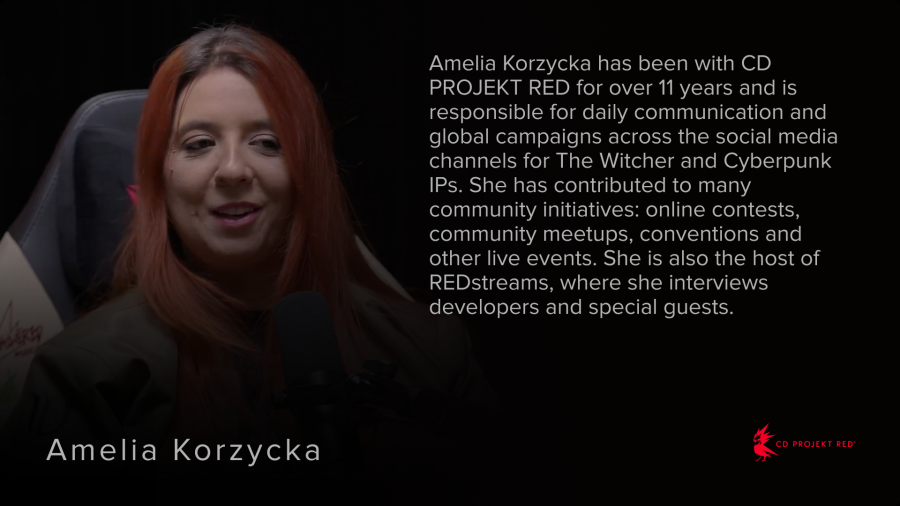
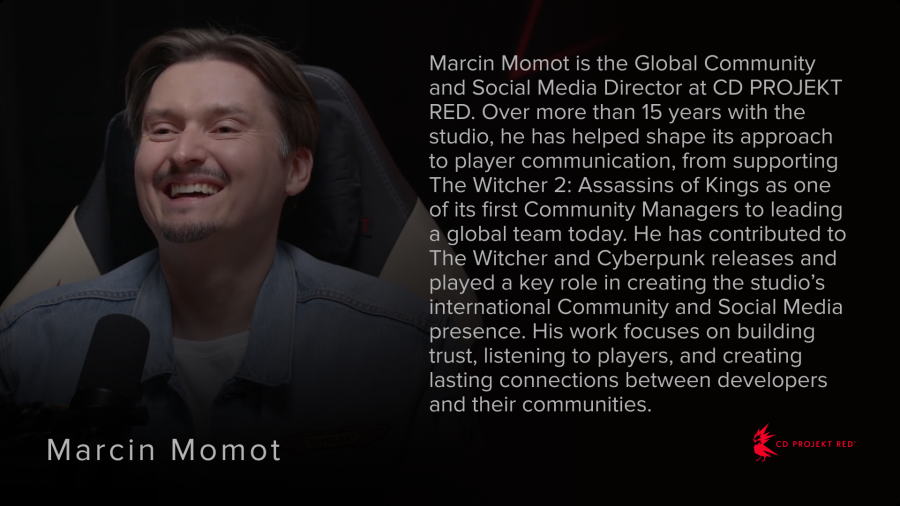
![AnsweRED Podcast Episode 33 — Growing the Vision: Boston and the Future of Cyberpunk [Transcript Included]](https://common.cdn.cdpr.app/cdpr/news/main/e3b89550d6f3b3b1e3db49d70c5c351d_q90_1280x720.jpeg)
![AnsweRED Podcast Episode 31 — People and Purpose: Shaping Studio Culture [Transcript Included]](https://common.cdn.cdpr.app/cdpr/news/main/03c393163707ede7eb317faf34c397d7_q90_423x238.png)
![AnsweRED Podcast Episode 30 — Paths and Possibilities: The Art of Level Design [transcript included]](https://common.cdn.cdpr.app/cdpr/news/main/41e6bae69f58881b2f5c3eba49e909a1_q90_423x238.png)