Always Remembering the Gamer
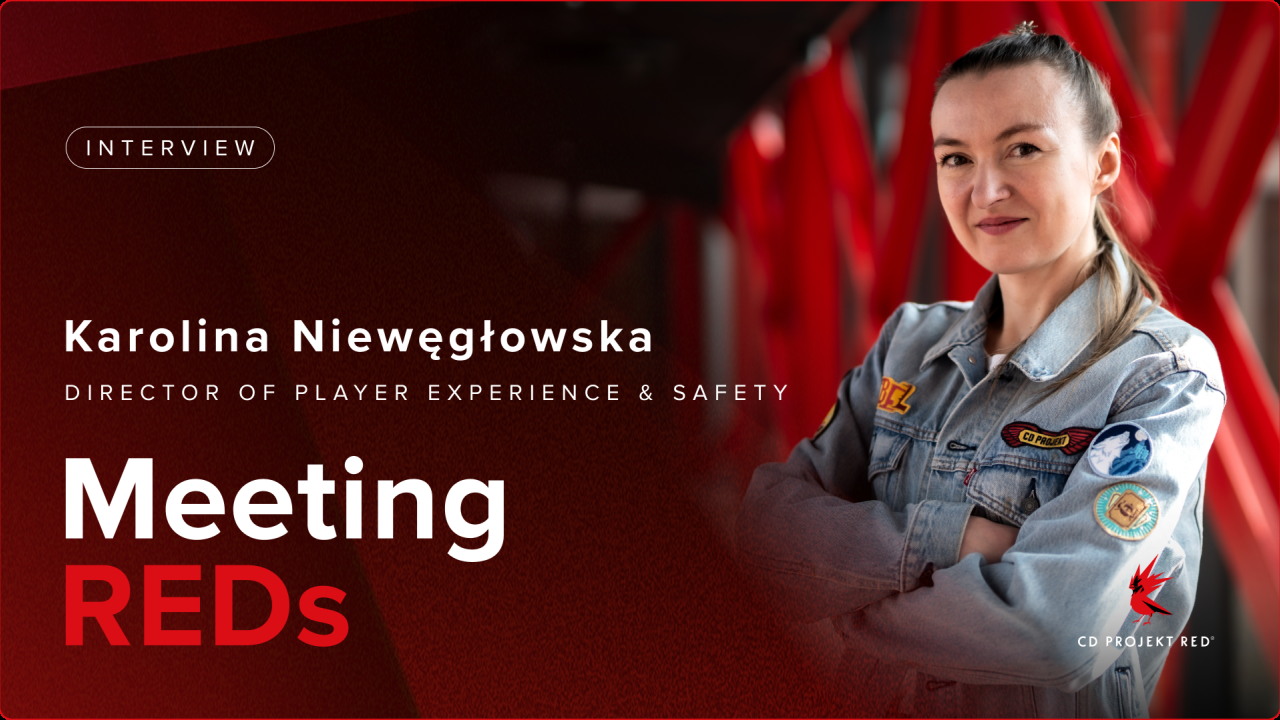
Karolina Niewęgłowska is our Director of Player Experience & Safety and this year celebrates 15 years at CD PROJEKT RED. Discover her path from joining the studio as a Beta Tester to forming and growing a brand new team.
Have you always been a gamer?
When I was a kid in Poland in the 90s I played games on handheld knockoffs, so that was my gateway into gaming. But the first PC appeared in my family home late, so I missed out on a lot of classics back then, and I got access to broadband internet only when I was a university student. That’s when I started intensively playing World of Warcraft and meeting other gamers from all around the world. I quickly realized that I loved games so much that I had to work with them — even though I was already working as a teacher and translator. At that time I also watched Jane McGonigal’s 2010 TED Talk Gaming Can Make a Better World. It strongly resonated with me because I felt gaming helped me see things in a more can-do way, and literally unlocked a meaningful new life path for me. I was inspired: by gaming, by Jane’s call to action, by game dev. And that’s also when my interest in the psychology of gaming started.
How did you start working at CD PROJEKT RED 15 years ago?
In a way, CD PROJEKT found me! I’d begun working in a playtesting lab the company owned in Warsaw, that was located in the same building and even floor that RED was. We were sitting wall to wall from each other, and since we sometimes tested games which required singing, it would lead to CD PROJEKT RED employees politely asking us to keep it down a bit. Then eventually, in 2011, I was invited to move to CD PROJEKT as a Beta Tester. I immediately felt I found my place on earth; everyone had each others’ backs and we were so excited about the game we were making — The Witcher 2: Assassins of Kings.
Did you join a dedicated technical support department?
We didn’t have an in-house team at the time, but when The Witcher 2 came out, we needed to change that. At first it was me, the Quality Assurance team, and others from the studio replying to players on forums and over email. Over time I got more and more involved until eventually I basically became a one-person tech support unit. It was manageable, but with The Witcher 3: Wild Hunt approaching, we knew we needed to build a team for the future — which I was tasked with.
What went into building a successful Player Experience team?
Our technical support is organically connected to the rest of the studio, with relationships developed over many years. After The Witcher 2 came out I started noticing trends in the bugs reported by players and shared my findings with QA. This kept evolving, and upon The Witcher 3: Wild Hunt’s release we started meeting regularly with other teams to discuss the most common issues and ways of addressing them. Adam Badowski, Studio Head of CD PROJEKT RED at the time and now our Joint CEO, and Kuba Kutrzuba, Engine QA Lead on The Witcher 3 and now our VP, Executive Producer of External Projects, would both regularly attend these meetings. So trust was built over time, and now we actively communicate with dev to discuss trends, note which fixes should be high priority, and provide input pre-release to improve player experience upon launch.
What’s it like working directly with players?
Sometimes the messages we receive can be emotionally charged, so it’s not always simple, but resolving players’ issues is a rewarding experience. When bringing in new people to the team, together with the Lead of Technical Support, we always look for applicants who have experience in dealing with people, whether it’s as a teacher, a police officer, or a shop assistant. Resilience, on top of being analytical and action-oriented, is important in this job. So is being a gamer, to understand other gamers. All of this allows working with players to be a positive experience, because it allows our support to be authentic. This is very important for me and our company on many levels. Our games have real emotions, and in the same vein, the people who directly communicate with our players are real too. Gaining mutual understanding is enormously valuable — both in work and life.
What does authenticity look like in practice?
If we answer you with “we are looking into it”, we really are. We are verifying the issue, examining your save, and passing that information to our development team. When we say “we are working on it”, the issue is logged in our bug tracking system and there are folks actively looking for the underlying cause and ways to solve the issue. It’s not always a straight or easy path, and there are times when what occurs on the players’ end does not occur on ours, for example. Sometimes we can’t reach a solution. But we’ll always do our best to resolve any issues. When we see an obstacle to enjoyment or an opportunity for improvement, we always pursue it.
How do you unwind outside of work?
I’m fascinated by the turn of the 20th century and early 20th century periods, especially in the Warsaw context. I read diaries from that era and look for additions to my collection of vintage items. Lately I’m also focusing on fashion and buying clothes originally from that period — and using every company event as an opportunity to wear them. At our last Christmas party I wore a dress from the 1920s! I also started fencing last year. I think it’s so full of grace; it’s a precise and beautiful sport. Maelle, a character in Clair Obscur: Expedition 33, which I loved, says “finesse and precision!” as she uses one of her attacks. And as I train, and I look around me at others training, the finesse, grace, and precision fills me with joy. I also moved one level up from being an established karaoke enthusiast at the company Social Fridays to actually taking singing lessons. I like to try a lot of new things, and when something does take hold of my imagination and I truly find love for it, I stay with it for a long time.
Does this philosophy apply to CD PROJEKT RED too?
Yes. Yes, it does. CD PROJEKT RED is my village. This is something very valuable, because I think it’s so difficult to find in the modern world. Everyone here is different and interesting in their own way — but at the same time we all try to create something great, and bigger than the sum of its parts. And that’s beautiful. There are so many passionate people here that I even formed a habit during lunch breaks to sometimes sit next to REDs I haven’t met yet. And after these conversations I think to myself: it’s just incredible how many different kinds of fascinating people work here!