From the RED Summer Internship to The Witcher 4
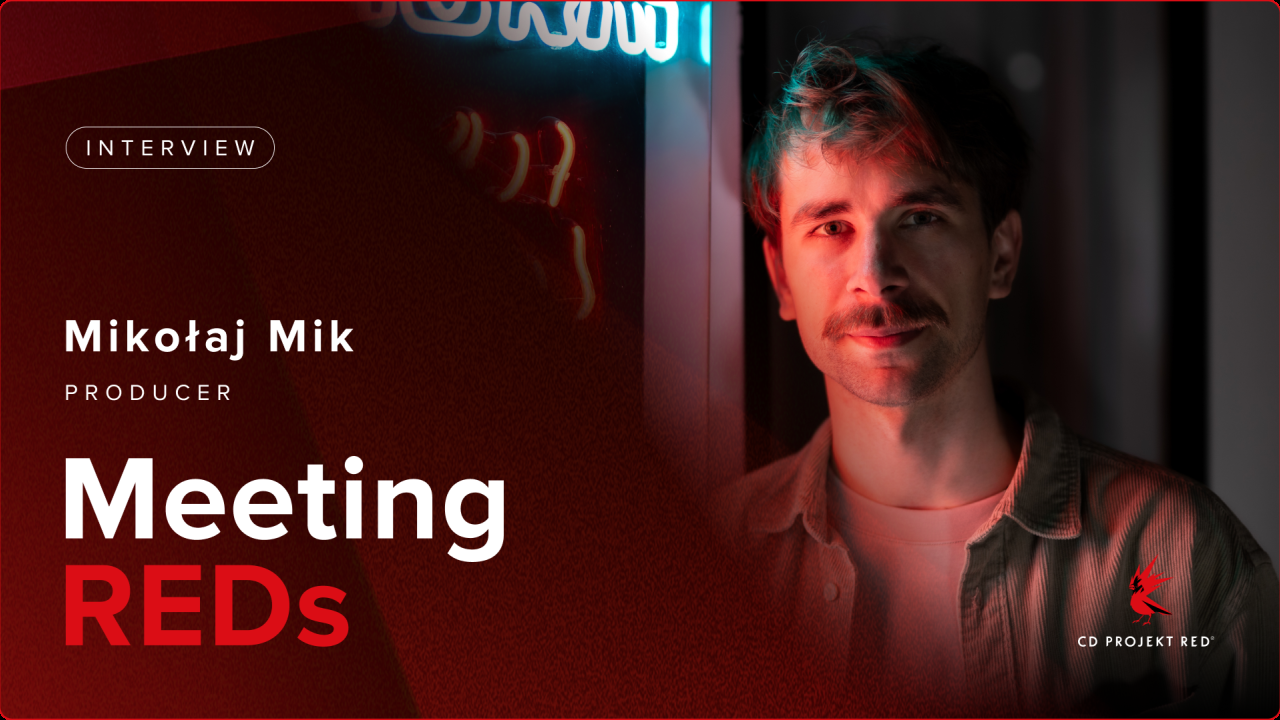
Mikołaj Mik started his CD PROJEKT RED journey as a Summer Intern in 2022 — and is now a Producer on The Witcher 4. Discover how he grew into that role, what production looks like behind the scenes, and his advice for aspiring game developers.
How did you become interested in game development?
Ever since my early teens, both cinema and video games were very close to my heart. Cinema came first — games as a career path had to grow in me over time. At first, I imagined a future in directing films, but experience showed me that production might actually be a better path for me. After studying Sinology for a while, I ended up at the Łódź Film School, where I focused on film production and met people who introduced me to the digital world. Later, through small personal projects and Unity prototypes I met a friend, Marcel Markanicz, who was already working as a producer in games. So when I moved from film production to game production, I realized that this is what resonated with me the most.
How were your first moments of the RED Summer Internship?
It was a fantastic experience. The moment I found out I was joining was incredibly exciting, and right from the beginning I felt very well taken care of; onboarding was smooth and my buddy and recruiters were on top of it all. When I joined the team I worked with the VFX, Lighting, and Gameplay teams on Cyberpunk 2077: Phantom Liberty. There was a bit of shock at joining such a large organization and entering a completely different reality from the one I knew from small projects. I think a lot of people who join RED near the beginning of their careers probably feel very similar — the first impression can be quite overwhelming, but in a positive way. I’m very grateful to my assigned buddy because from day one she sat down with me and helped me navigate the basics of the whole game development process.
What did you learn during the RED Summer Internship that you still use today?
My first task during the internship was to reorganize the production backlog and import it into a new system. That task was perfect for me in the beginning; I had to understand what each item was, ask team members for clarification, check their statuses, and so on. And this is something I still do, and still enjoy. That was probably the moment I genuinely thought, “Okay, I’ve ended up in the right place. If even a routine task can be this satisfying, then I must be doing something I enjoy.”
Do interns have a real impact on their team’s work?
Absolutely. While working on the project I mentioned, there was a situation where I proposed a new solution for presenting work progress. The reaction I got was, “Okay, let’s talk about it,” and I was very proud when my idea was implemented across the whole team.
What is your proudest moment from the RED Summer Internship?
Two months into the internship, my buddy said: “Alright, Mikołaj. I don’t know what to do next because we finished the entire three-month program in two months.” That is something I was really proud of. Beyond that, simply completing a lot of good work — even though plenty of things could have gone wrong along the way — is something I look back on fondly and with pride.
What’s your day-to-day like on The Witcher 4?
This may sound like a cliché, but every day is different in this job… A producer’s work is mainly based on the teams’ output, so we’re doing whatever we can to help our teams work effectively. On the one hand, that is very exciting, because when we set up a team, we can adjust its work methodology depending on the stage of development. But we also have a real impact on people’s work, so the role comes with a lot of responsibility. On top of that, as producers, we set priorities, measure, and report on progress. For example, we figure out when work on a given quest can be completed, come up with solutions to make sure it happens, and coordinate with other departments that are also connected to this work. It’s the producer's role to make sure everything happens on time and in the right order.
What can aspiring production interns do to increase their chances of entering the industry?
What I would definitely recommend is to complete as many projects as possible — and different kinds of projects — as an organizer. Game projects are obviously the best, but not everyone has the opportunity to work with those. I think any coordinating or organizational work will be appreciated. Besides that, it’s worth being familiar with the industry, and being a gamer definitely helps. Producers have to make a lot of decisions that can impact gameplay, and being able to see things from the player’s perspective can be very helpful. Task management tools are very useful, as is familiarity with spreadsheets and other project management software, such as Jira. It also helps to have some awareness of different management methodologies, even if you don’t have much hands-on practice with them. And, of course, it’s always a good idea to make your own projects or prototypes in a game engine; this gives you technical knowledge that makes it much easier to enter into conversations with developers.
Is technical knowledge essential in a video game producer’s work?
When I applied, the team was looking for someone with a skill set connected to special effects and film. But when we hired an intern for our team last year, we needed someone with a knowledge of programming. So it depends, especially since producers are often hired with a specific team or speciality in mind. It’s definitely worth having a versatile skill set and familiarizing yourself with as many aspects of production as possible. That’s why people who have tried to create their own projects will definitely have a big advantage. It doesn’t have to be something that was released, or anything ambitious or large. But if someone has gone through their own project and had the opportunity to get familiar with, for example, doing a bit of concept art, writing a short script, recording something, animating something, creating an environment… If they have had the chance to come into contact with each of those things, then that is definitely valuable experience for a producer.
What advice do you have for interns joining CD PROJEKT RED?
I think the most important thing is to be as proactive as possible. Be open, talk to each other, and learn from one another. Get to know not only your own disciplines but also the other parts of creating a game. For me, it was a really great experience to meet all those people — some of whom I still work with today — and through their first steps, learn more about the specific disciplines and domains they were working in. Also, do not be afraid to ask questions! Why is it done this way? Why can’t we do this? You’ll learn a lot from asking questions like these.
What was it like seeing your name in the Phantom Liberty credits?
It was definitely an emotional milestone — and the peak of my career at that point. It was my first release, after all. I think most people remember their first release for a very long time, and I know I'll remember mine for the rest of my life.